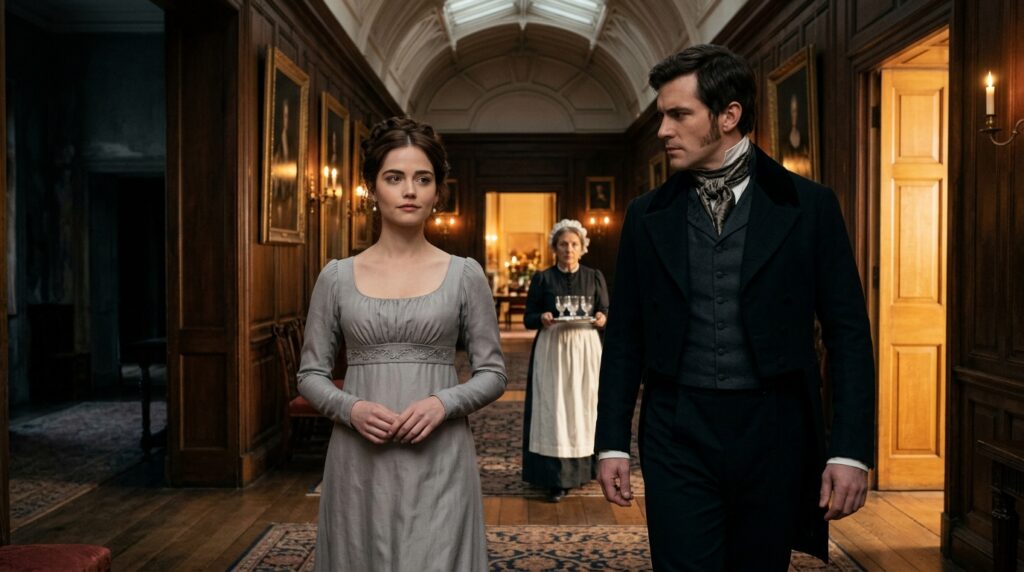
He said it on a Tuesday evening in the corridor outside the dining room with the candles still guttering from the draft of the closing door. Mrs. Tull was three paces behind them carrying a tray of cleared glassware, and she heard every word.
“You will sleep in the East Wing until you learn your place.”
Phoebe Croft, who had been Phoebe Waverly until 6 weeks prior, stopped walking. She did not turn. She did not ask him to repeat himself. She stood very still in the corridor with her hands folded at her waist while her husband’s footsteps continued toward his study.
And when the door closed behind him, she remained where she was for another moment, not collecting herself, not trembling, not doing any of the things a woman in her position might reasonably have done. She was thinking. Then she inclined her head slightly toward Mrs. Tull and said:
“I shall need fresh linen sent across, if you would be so kind.”
And she walked toward the East Wing as if she’d always intended to sleep there.
The East Wing of Aldenmere Park had not been properly inhabited in 11 years. It had been built in the previous century as a mirror to the West Wing, identical in proportion if not in grace, but the late Duke had closed it after the last of his sisters married and moved to Dorset. Since then, it had served as a repository for furniture that no longer suited the principal rooms, for trunks of clothing belonging to people who had died or departed, for the slow accumulation of things a great house cannot bring itself to discard. The corridor smelled of cold plaster and beeswax gone stale.
The wallpaper in the largest bedchamber, French hand-painted, once the pride of the Duchess who had commissioned it, had begun to peel at the seams where damp had crept through the north-facing wall. Phoebe stood in the doorway of this room and looked at it for a long time. Then she set her candle on the mantelpiece, opened the window to let the night air move through the staleness, and began to make a list. She had always been a woman who made lists.
Her father, a solicitor in Hertfordshire with more daughters than prospects, had raised her on the principle that any situation could be improved by a clear inventory of its deficiencies. Phoebe had four sisters, all of them prettier, all of them louder, and she had learned early that the one who noticed what was missing was more useful than the one who lamented what was lost.
When Nathaniel Croft, the sixth Duke of Aldenmere, had been persuaded by his mother and his solicitors that a wife was necessary for the succession, for the estate, for the appearance of stability that creditors and tenants alike required, Phoebe Waverly had been selected not for her beauty or her connections, but for her willingness. She had been willing. That was the sum of her qualification, and Nathaniel had resented her for it from the first morning of their marriage.











