“Let the Governess Play,” They Laughed. The Duke Stood Up at the Third Note.
“Let the governess play.”
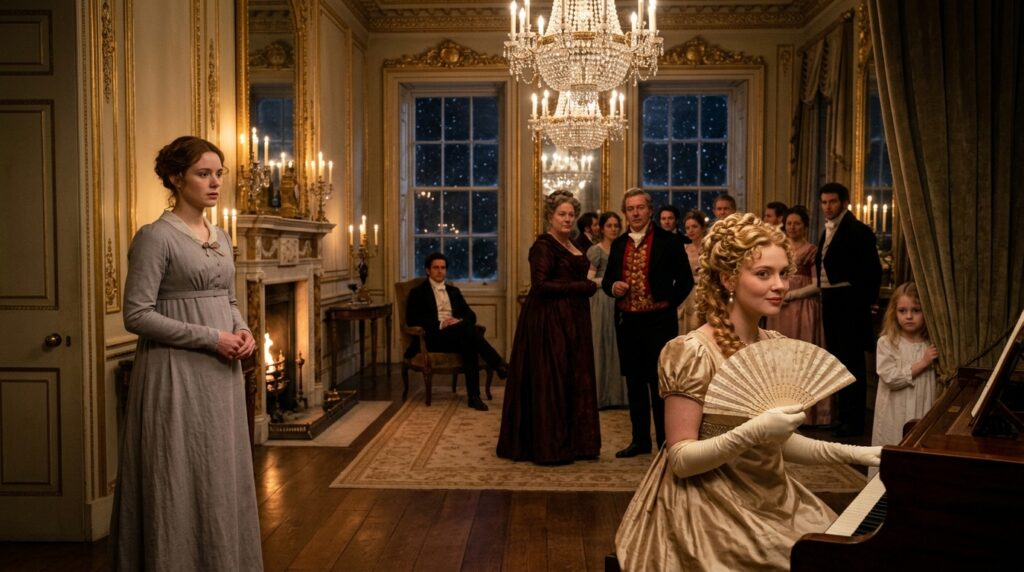
Lady Cecily Pembroke said it with a little laugh as she rose from the pianoforte bench in the gold drawing room of Ellsworth Hall, and she pointed her closed fan at the young woman in the plain gray dress standing quietly beside the door. For a moment, no one understood. Then, one by one, the 20 guests in their silks and jewels understood, and the laughter began, soft at first, then not soft at all.
“Oh, do let her,” chuckled a gentleman in a red waistcoat. “I should love to hear what they teach in the servants’ hall.”
“A country jig, perhaps,” said Lady Cecily’s mother, the Countess of Dunmore, and the laughter rose again.
Miss Anna Hartwell’s cheeks burned. She had only come downstairs to fetch little Lady Philippa, who had crept out of bed and was hiding behind the velvet curtain of the music alcove. Governesses were meant to be invisible, but now every eye in the room was upon her. Without meaning to, she looked toward the tall window at the far end of the room, where the Duke of Ellsworth sat alone. Gideon Marlowe had not laughed.
In 3 months beneath his roof, Anna had learned there was one rule at Ellsworth Hall that no one dared to break. No music, not a note, not a hum. Tonight, he had allowed it only because his aunt insisted, and he had endured it in stony silence. He did not look at Anna now. He did not lift a finger to stop it.
So, Anna lifted her chin, crossed the long room, and sat down at the pianoforte while the laughter washed around her like cold water. The first note fell into the room, soft and low. The second followed, gentle as a footstep. And then came the third note.
A strange note. A note that stepped sideways where it ought to have stepped forward. A note that any music master in England would have called a mistake. Lady Cecily laughed out loud.
“There, you see? She cannot even…”
She never finished. At the far end of the room, the Duke of Ellsworth had risen to his feet. His chair scraped back across the floor so sharply that every voice died at once. Anna turned on the bench and saw his face, and it was white, not angry, not cold, white as though he had just watched a ghost walk through the wall.
“Where,” said the Duke of Ellsworth, in a voice no one in that room had ever heard him use, “did you learn that?”
Now, to understand why a proud and frozen Duke would rise from his chair for three small notes played by a governess, we must go back three months to a wet October evening, to a hired coach rattling up a long dark drive. And to a young woman who had nothing left in the world but a battered trunk and a folded sheet of music she had promised her father she would never lose. The coach set Anna down at the foot of the great stone steps just as the rain began in earnest. Ellsworth Hall rose above her in the gloom. Three stories of gray Derbyshire stone with a hundred windows, and only four of them lit.
It did not look like a house that was waiting for anyone. It looked like a house that had stopped waiting a long time ago. Anna gathered her cloak, paid the driver with the last of her coins, and climbed the steps. She was 24 years old. Six weeks earlier, she had buried her father in a small churchyard in Clerkenwell with only the vicar and their landlady to stand beside her.











