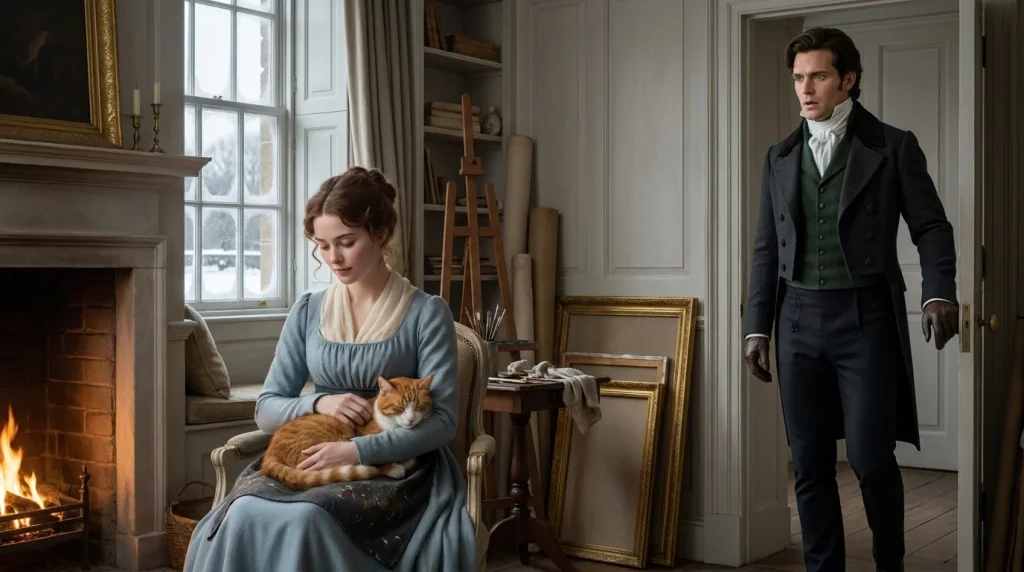
“The duke has returned, and he means to sell the house,” Silas said.
He stood in the workshop doorway, the cold flowing around him like water around a post. Frost covered his hat and white beard, and his breath rose in a cloud beneath the lamp.
Susanna Quinn did not put down her swab at once. She had been working since noon on a small, dark painting of a river. She had just reached the point where a boat was beginning to emerge from the brown haze, with a tiny white sail that no one had seen for a hundred years. She finished the stroke. Then she set the cotton in its dish, wiped her hands on her apron, and went to help the old man out of his coat before he could struggle with the buttons.
“Sit beside the stove,” she said, “and tell me properly.”
Silas let her help. That was how she knew the news was bad. On a good day, he would have told her he was not so old that a girl needed to undress him like an infant. Tonight he merely sat, his trembling hands held toward the iron bars, and looked at the little painting on her easel as though it were the last thing in the world that made sense.
He had walked the long road from Southwood in the dusk, past frozen ditches and willows standing beside the road like old men waiting for a coach. It was a considerable walk for a man of his age in January. He had made it because he did not want to send a message about something like this.
“He came yesterday,” Silas said. “Nicholas, the Duke of Delecour. Her ladyship’s godson. You’ve heard her speak of him?”
“Every winter of my life,” Susanna said.
At last he had come, fifteen years late and three weeks after the funeral, and he had not come to stay. He intended to sell Southwood: house, land, furniture, pictures, every cup and every chair. A man from Bridgewater would conduct the auction in the great hall on the last day of the month. Before then, the duke wanted all the paintings in the house cleaned so that they would fetch their proper value.
Silas laughed, and the laugh turned into a cough.
“He asked for me by name. The steward told him there was no better man in Somerset. So I have the commission.”
Susanna looked at his hands. They rested in his lap, and even there they could not keep still. They had not been still for four winters. Nobody in the village dared to say it plainly to him, and nobody needed to. Every picture that left this workshop carried Silas’s name on the paperwork. Every gentleman who sent one believed the old master had cleaned it himself. Not one had thought to ask about the young woman who carried his bottles. She was part of the workshop, like the stove, the easels, and the smell of turpentine. She had been there since she was twelve. She was twenty-three now.
“Then I shall go to Southwood,” she said.
“You shall go to Southwood. You’ll do the work, I’ll take responsibility, and the duke will pay for what my hands can no longer do.”
He said it without pride or shame. It was simply true, and Silas had always preferred the truth.
“There’s more, Susanna. This cottage belongs to Southwood. So does the workshop. Her ladyship never took a penny of rent, but it was always hers. Now it is his. In a month it will belong to whoever buys the house.”
She knew that already. She had simply never allowed herself to think about it. The little cottage stood at the village’s far end where the road opened onto the moor, and her ladyship had given Silas its use in the year he returned from London. Everything Susanna possessed was in those two rooms: her bed upstairs under the thatch, her mother’s shawl behind the door, and her own small paintings, made for nobody, stacked against the wall of the back room. If a stranger bought Southwood, that stranger would decide whether any of the cottages on the estate remained standing.











