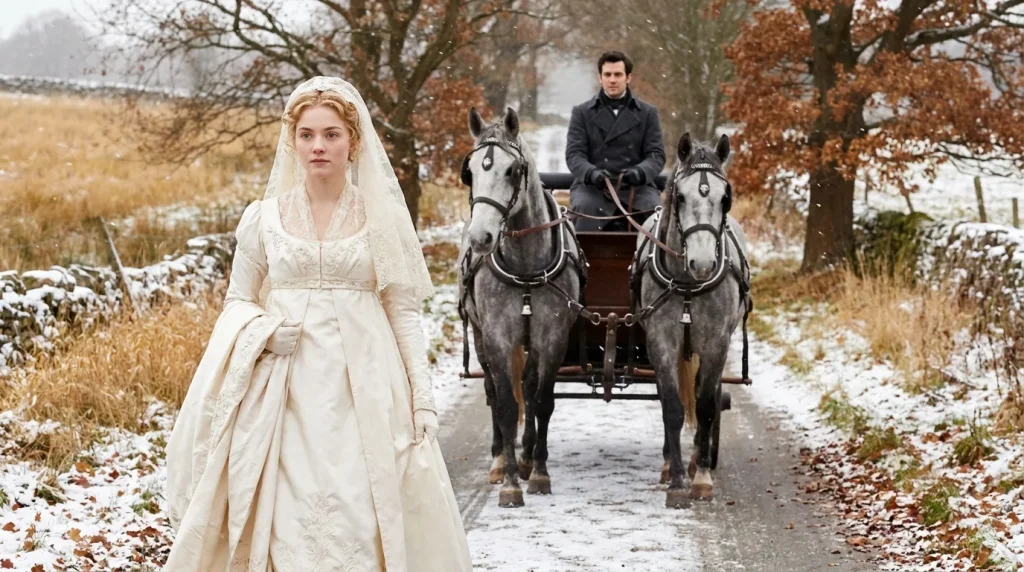
She was abandoned on Christmas Eve and walked away in the snow in her wedding dress. What she didn’t know, what no one in the little stone church in Thistlewood knew, because they were all still staring at the door she had left swinging open, was that the Duke of Harlow’s sleigh was already arriving by the same road with two grey horses, 40 bells and a coachman who hadn’t laughed for 11 months. Her name was Marjorie Ladd. She was 26 years old.
She was a candlemaker by trade, meaning she made candles, and she had stood in front of St. Jude’s altar for 1 hour and 9 minutes. The dress belonged to her mother. It had been widened at the waist, taken in at the shoulders and washed with rainwater; It was the color of stale cream, and it was definitely not an outfit for going out in December.
At 1:10, the blacksmith’s son walked back up the path, snow on his cap and a folded piece of paper in his fist. Marjorie read it standing up. It was four lines long. It was signed C. Vale, with a flourish on the V, because Crispin had always loved that flourish more than anything in the world.
Then she folded it very carefully along the same creases and handed it to the vicar as if she were returning a borrowed dish. He married Miss Honoria Dacre, she said, in Wetherby this morning. His father owns the brewery. The church emitted a sound, not a word, a sound, the kind 60 people make when they all breathe in at the same time and none of them has anything to say.
Mrs. Tibb, who sells ribbons, began to cry for Marjorie, which Marjorie thought was generous because she had no intention of crying herself. “My dear Marjorie,” said the vicar, “please sit down.” No, thank you. It’s 6 kilometers to Abbey Road and the snow is starting to really fall.
“Then I’d better go,” said Marjorie Ladd, and she walked down the aisle of St. Jude in her mother’s wedding dress, past her neighbors, past the holly they had nailed to the pews that morning, and out the door in the white. Here is the part that she could never explain afterwards to anyone, including herself, including her own children, who questioned her about it every Christmas Eve for the next 30 years. She did not return home. The house was 200 meters away.
It was the candlemaker’s shop on Fold Lane, with her father’s name still painted above the door and her bed in the room just above. The house was cozy, with a kettle and a door that closed. She turned in the other direction. She walked up Fold Lane to the top, passed through the gate and emerged onto Abbey Road, which stretches for 6 kilometers across the moor to Harlow Abbey, with nothing on either side except stone walls, sheep and the weather.
She was not carrying a lantern. She was wearing delicate white shoes. And if you had asked her why, she would have told you the truth, which was this. There were 840 candles in her workshop, which she had made with her own hands for the Abbey’s Lantern Night.
They were to be delivered to the door of the abbey kitchen before 6 p.m., and Crispin Vale had taken the cart. She heard the jingle bells first. Forty of them, small ones, the kind that are sewn onto harnesses for no reason other than someone’s grandmother thought a sled should sound like a sled. They emerged from the bend behind her, all at once: forty bells, two grey horses and a long black body on skids.










