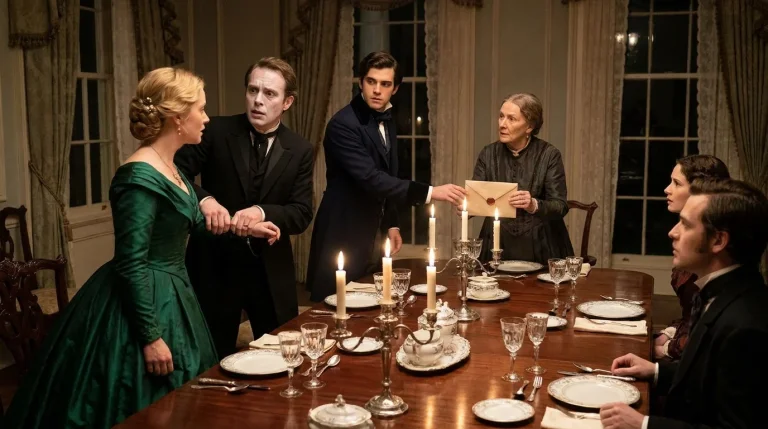
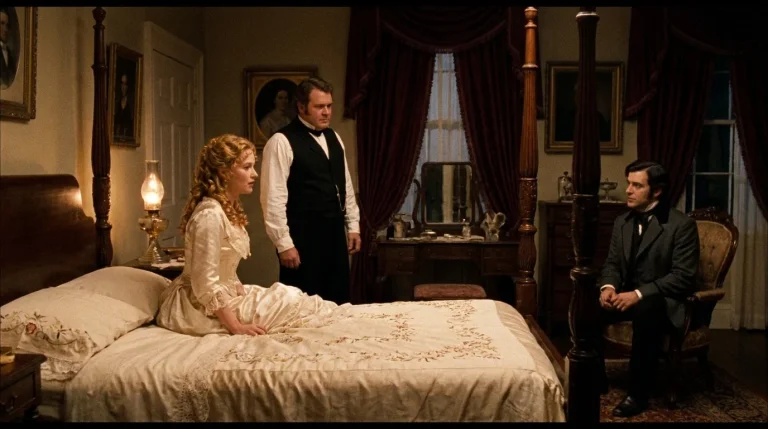
He married Honoria Dacre this morning instead. The kitchen welcomed the news. The brewer’s daughter, said Mrs. Oad. The brewer’s daughter.
Hm. Mrs. Oad returned to her pastry shop. So he’s a fool, she caught him, in four years she’ll realize it and you’ll sleep soundly. Eat your broth.
And Marjorie Ladd, sitting in a dress borrowed from the end of a scrubbed table in an unknown house, with her mother’s dress drying upstairs and her whole life turned upside down, ate her broth and discovered with a kind of astonishment that she was hot. This lasted until 4:20 PM. At 4:20 PM, the cart returned to the yard, and it was going fast, which was not normal, because a cart carrying 840 candles does not return at a speed. Marjorie was already out of the kitchen before anyone had even put down their spoon.
Joss stepped down from the seat, hat in hand, with an expression on her face that she would remember all her life. “Miss Ladd,” he said, “the shop is open, the doors are open, and the locks have been opened with a key, not forced.” And there’s nothing left inside. The snow began to fall.
What do you mean by nothing? “I mean nothing at all, miss,” replied Joss. No crates, no candles, no tallow, no wax, no wicks, no molds. All that remains is a cold vat, a swept floor, and a nail where the register was hanging.
Whoever did this came with a cart, took everything and left by the Wetherby road, because the ruts are still visible under the fresh snow. 840 candles, 15 pounds 15 shillings, 312 windows and 5 hours before nightfall. Marjorie Ladd stood in the snow, in her maid’s dress, and did calculations. That’s what she was doing.
Others were crying, sitting down, or asking why she was keeping accounts. She had been doing it since the age of nine, because her father had taught her that a candlemaker who cannot count is a man who burns his own money in his own shop. 840 candles disappeared. Three weeks of work gone.
Four bundles of cotton wicks have disappeared. The molds, her father’s molds, 48 of them in tin, with “Ladd”engraved on the base of each one, gone. And the vat, he had taken the vat.
“He didn’t steal them,” she said. Joss blinked. Miss, he didn’t steal them. His voice came out very calm, as if from afar, which happened when his anger exceeded the ordinary.
He used a key. He has a key because he had one, because in October, I gave him one. She turned around. And he will say, he will stand before a magistrate and say that in August he advanced 19 pounds for the case, that we signed a paper, and that this paper stipulated that the stock of the shop served as security until our marriage, and we did not get married because he did not come.
So the stock belongs to him, the law will probably be on his side, the law will be wrong, and the law won’t care about being wrong. “Miss Ladd,” said a voice behind her. She did not turn around. Not now.
Miss Ladd, there is a man in my hall with a letter. She turned around. There were, in fact, two men. One was the old man in black, Stebbins, standing at the top of the steps like a heron.
The other was short, neat, in his sixties, with glasses pushed up over his grey hair and an elastic band around a stack of papers. He trotted down the steps with the expression of a man bringing bad news that he had rehearsed.