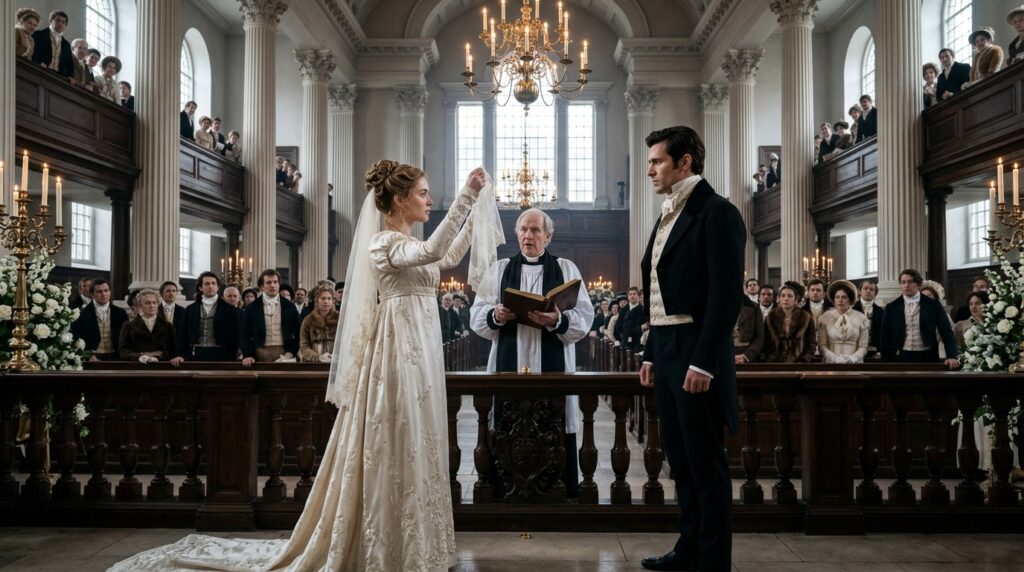
The veil landed at his feet like a sentence he hadn’t finished speaking. 300 guests watched it fall. The bishop watched it fall. The 12 candles on the altar watched it fall, and not one of them had the decency to go out. The Duke of Brentford stood at the altar of St. George’s, Hanover Square, with his hands clasped behind his back, and his jaw set in the particular arrangement that his secretaries recognized as the last warning before something irreversible happened, and he watched his bride of approximately 4 minutes turn and walk back down the nave without him.
She did not run. That was the thing London would argue about for weeks afterward. Lady Isabel Vance did not run. She walked with the deliberate, unhurried step of a woman who had already decided everything, and was merely completing the final administrative detail of a very long and very private war.
The train of her gown whispered against the stone. The door at the far end opened. Then, she was gone, and the only evidence she had ever stood at that altar was the veil white against the cold marble and the ring which she had left on the bishop’s open Bible like a bookmark in a chapter she refused to finish.
The Duke looked down at it for a moment that lasted considerably longer than any moment had a right to last. Then he said, in the voice that had once silenced the House of Lords:
“Keep the dowry.”
Not to anyone in particular. Not to her retreating figure, which was already beyond hearing. To the room, perhaps. To the 300 witnesses arranging their expressions between shock and appetite. To himself.
“She may keep all of it.”
What no one in that cathedral knew, not the guests, not the bishop, not the duke himself, was that Isabel Vance had not left because she wished to humiliate him. She had left because of what she had found in his desk three days before the wedding. Folded inside an envelope she was never meant to open addressed in her own mother’s handwriting to the late Duke of Brentford dated six weeks before her mother had died. And somewhere in that letter was a name, his father’s name, and a debt that had nothing to do with money.
The carriage was already moving by the time the first whisper reached the back pews. Isabel had arranged this with the same precision she had applied to everything in the three days since she had found the letter. The carriage was hired, not a Vance carriage, not a Brentford carriage, nothing that could be stopped by a family name or a duke’s authority. The driver had been paid twice, once to be ready at 11:00 and once to ask no questions.
She had a bag. She had money of her own, not much, but enough. She had the letter folded inside the bodice of her wedding gown because there was no pocket in the world deep enough for what it contained.











