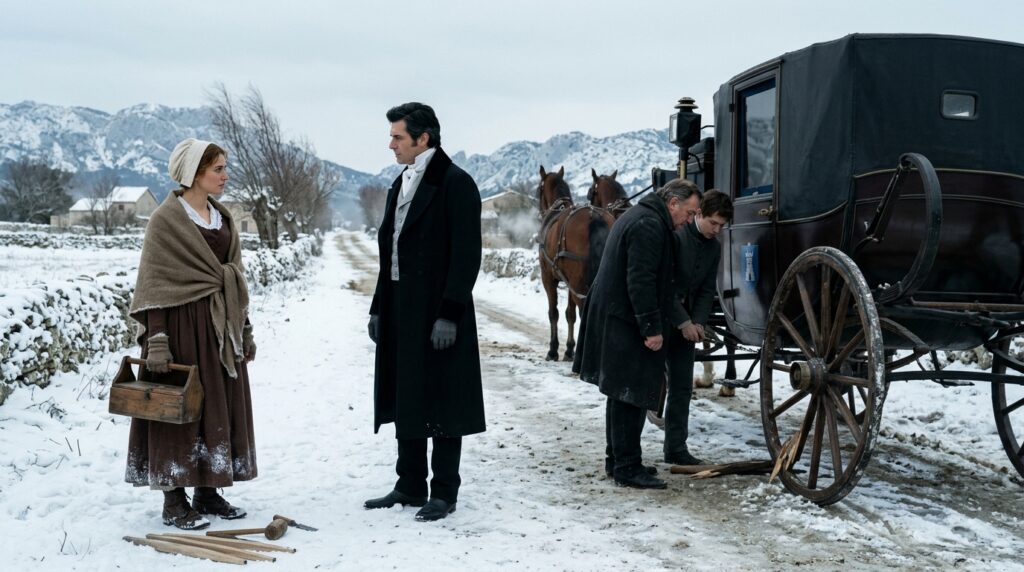
The wind changed direction, bringing the metallic smell of rain, and then the clouds broke apart all at once. The water poured down on Saint-Rémy in thick curtains, turning the streets into streams, the road at the entrance to the village into a dark, slippery mud pit. It was on this road that the carriage broke down. It was a carriage like few others seen there, black, lacquered, with a discreet coat of arms painted on the door, a silver tower on a blue background, pulled by four bay horses, running too fast for that time of year.
And when the left rear wheel struck a stone hidden under the mud, a dry crack was heard, like a bone breaking. Three spokes broke at the same time. The carriage tipped over, tilted, the driver shouting to hold the horses. A village boy ran to the Fournier’s workshop, soaked and breathless.
“A gentleman’s carriage broke down at the entrance. Do they need someone?”
Gaspar sat near the stove with his feet on a stool, looked out the window at the torrents of water running down the glass, and didn’t get up.
“In this weather, let him wait until tomorrow.”
From the back of the workshop, Élise was already getting the toolbox. She tucked three ash beams under her arm, grabbed the lantern, pulled the woolen hood over her scarf, and left without saying a word. Bert, who was upstairs, didn’t see. Henri de Valcour, Duke of Valcour, stood waiting in the rain beside the overturned carriage. He had refused to stay inside.
He was 39 years old and had a presence that seemed to occupy more space than his own body. He was tall, with broad shoulders that perfectly filled a black English woolen overcoat, now darkened by the rain. Underneath, a pearl-gray silk waistcoat and a white tie already ruined by the rain. His hair was black, combed back, and beginning to show silver strands at the temples.
His eyes were a cold, greyish-blue, the exact color of the winter sky over the sea, and they had a habit of lingering on people, as if assessing their weight. And on his hands, dark grey kidskin gloves, gloves he never took off, not to eat, not to write, not to greet anyone. Henri had been a widower for eight years. Since then he had lived in Paris and in the family castles like an elegant shadow.
He frequented the salons, fulfilled his duties, managed the lands, but he didn’t laugh, didn’t linger, didn’t approach anyone. He had returned to Provence that autumn with a single purpose, which he had explained to his administrator with the coldness of someone discussing a land purchase. To choose a suitable wife, from a good family, healthy, and to secure an heir for the title. A contract, nothing more.
When he saw the small figure appear on the road, carrying a lantern and a toolbox, he initially thought it was a boy. Only when she approached and the light fell on her wet face beneath the hood did he realize it was a woman. She didn’t curtsy, didn’t introduce herself. She looked at the wheel, then at him, and said simply,











