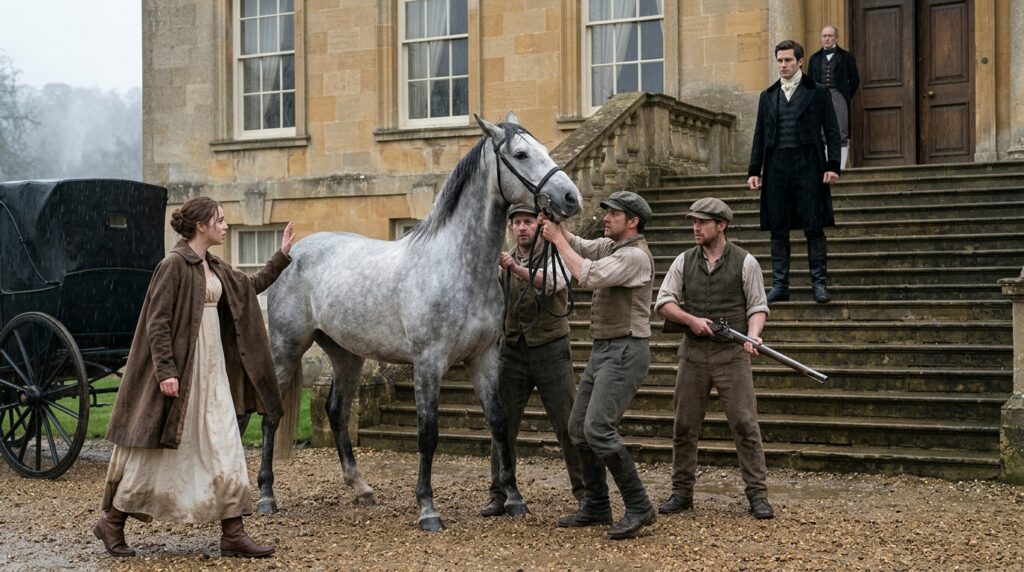
That was the trouble with being right. It sat in you like a swallowed stone and would not be forgotten however sensibly you told yourself to forget it. The Duke of Northwell noticed her the way one notices a change in weather without wanting to and all at once. He did not go to the kitchen or the still room.
He was a duke. Those were another country. But he could not help observing that the flue no longer smoked at breakfast. That the coffee was hot.
That the great cold dining table at which he ate alone in silence every night 17 ft of mahogany with one place laid at the end of it had one evening been shortened. He came down to dinner and the extra leaves were gone. The table was a modest 6 ft. His single place was laid at it and it no longer looked like a man eating at the end of a coffin.
“Who did this?” he said to Dorset.
“Miss Eldstone thought Your Grace might dine more comfortably, sir. She said a man ought not to have to shout the length of a barn to ask for the salt.”
A pause.
“Shall I have it put back?”
The Duke looked at the small, warm table.
“No,” he said.
He met her 3 days later in the long gallery by accident, which was the only way he met anyone that year. She had a basket of mended linen on her hip and a smudge of beeswax on her wrist. And she stood aside for him against the wall, eyes down as a servant should. He went past her. Then he stopped.
“You are the woman with the mare,” he said.
“Yes, Your Grace.”
“My grandmother has set you to the linen.”
“Among other things, sir.”
He looked at her then, properly looked for the first time since the forecourt, now that she was dry and it was daylight. She was small and quiet and brown-haired. No beauty. The kind of woman a ballroom would look straight through.
Except that when she raised her eyes to answer him, they were level and gray clear and entirely without fear. And he had not been looked at like that by anyone in a year. His servants looked at the floor. His grandmother looked through him.
This woman looked at him as though he were simply a man who had asked her a question and she had the answer and she was deciding how much of it he could bear. It unsettled him. He was not used to being seen.
“The mare is sound,” he said abruptly. “The shoulder healed.”
“I’m glad, sir.”
“You were right. She was worth more than a fright.”
He seemed to want to say something else and to have no idea how.
“That is all,” he said and went on down the gallery and did not know why his own house felt for a moment less like a tomb.
Juliet stood with the basket on her hip and watched him go. She thought, “There is a good man in there drowning.” And then she thought about the butcher’s five shillings, the roof over the east wing, the 4,000 pounds in Silas Probin’s strong box. She told herself firmly that none of it was her affair. She was here to be invisible for 3 years.
She was not here to save a duke. She very nearly believed it. The month passed. Juliet did not leave. Nobody remarked on it in words, but the house remarked on it in a hundred small ways.
The maids, Prue and the two younger girls, brought their troubles to her now instead of weeping into the coal scuttle. Mrs. Tolley cooked like a woman released from prison. Amos, the head groom, was a taciturn Yorkshireman of 50. He touched his hat to Juliet as he would to a mistress. She had saved the gray.
She came out on frosty mornings and knew a splint from a windgall. Even Dorset, who trusted no one under 60 on principle, had begun to bring the household questions to her that he had used to carry uselessly to a grieving master’s shut door. She had, without a title and without wishing it, begun to run the house. And the more of the house she could see, the worse the accounts looked. It was not only the butcher.











