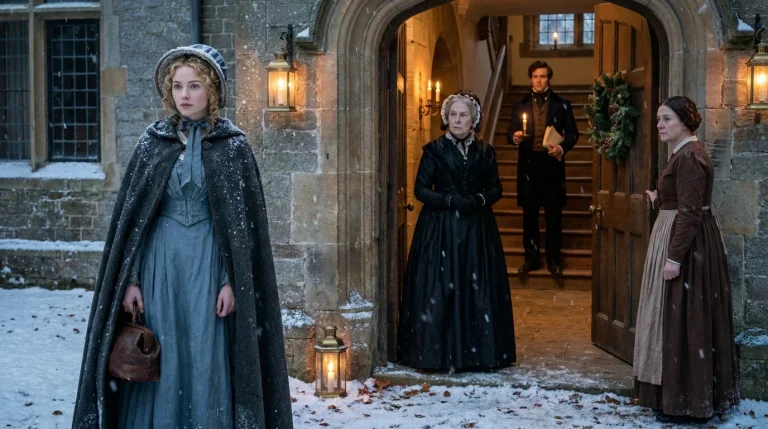
The duke said nothing to that. He stood in the courtyard until the last lantern had gone back down the avenue. He did not look at the east window. He did not look at his steward.
“We will speak in the morning,” he said.
He did not say the word Bath again. She went indoors with her lantern and her question. She understood nothing except that she had braced for a blow and been handed a silence. She did not yet know what the silence would cost.
The duchess’s bedchamber smelled of cold ash, damp wool, and a courtesy nobody meant. One scuttle of coal stood by the grate. It was the same scuttle as yesterday’s. It would be the same scuttle tomorrow. She knelt and built the fire as small as a fire could be built.
Then she sat with her father’s pocket ledger open on her knee. It was a brown book with a split spine. She carried it because she had nothing else of his. Every night she wrote in it from the front, and tonight she wrote, “One scuttle, day 206.”
The door opened without a knock.
“Still up, my dear?”
The Dowager Duchess of Raisford came in on a cloud of lavender water, in gray silk and a good many pearls. She was sixty and wore it like a coronet. She looked at the grate.
“You are very warm,” she said.
“I am not.”
“Warm enough, then.”
The dowager smiled.
“I have done so much for you, Hester. You must see it. Coal is dearer this winter. Candles are dearer. One economizes, and one does not complain, and one is grateful.”
“I am grateful,” said Hester.
It was true in the way a tally is true. It added up to exactly what she had been given.
“My son has come to his senses,” said the dowager. “I always said he would.”
“You wrote to him.”
“A mother writes.”
She patted the bedpost once, like a woman closing an account.
“Good night, my dear. Do try to be gone with a little grace.”
The door closed. Hester did not weep. She had stopped at sixteen, on the afternoon the bailiffs priced her mother’s piano at four pounds ten shillings. She had stood in the hall and watched it go out in a cart. She had understood that tears were an item nobody would ever buy.
She had not wasted them since. Instead, she looked at the dark window, and the window gave her back the night six months before. The wedding night had smelled of candle smoke and new linen. She had sat on the edge of an enormous bed in a nightgown that belonged to someone else. The duke had stood at the window with his back to her.
His hands were stained with ink to the second knuckle. He had spoken to the glass.
“I will be plain, Miss Brandreth.”
“I am Your Grace’s wife.”
“You are on the register,” he said. “It is not the same.”
He turned. He was thirty-two, hazel-eyed, brown as a groom, with the first gray coming in at his temples. He looked at her as one looks at a document that has arrived correctly signed.
“Your father’s debts are discharged. Your name is safe. You will be kept in every comfort this house affords. I require a signature and a woman who will not be harmed by what follows. I require nothing else, and I will not pretend to.”
“What follows?”
“I leave at dawn.”
“For how long?”
“I cannot say.”
She had known what she was worth. She had been told it by experts. A name without money was a figure written in red.