It was the only honest signature in ten years of the trust’s books, and a man had been ruined for refusing to add to it. The man was dead by then. His daughter was not. He had told himself it was a debt. He had told himself that for six months, across the Channel, in cold inns, with a lease in his saddlebag.
It had not stayed a debt. It had become something he could not write down. If she went to Bath tomorrow, he would not stop her. He had said so, and he meant it. He sat there until the fire was ash, and he found that meaning it was the most expensive thing he had ever done.
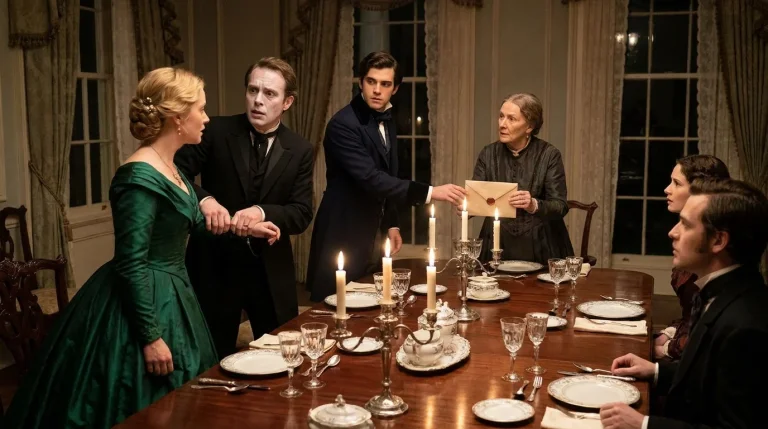
The next morning, she came to breakfast with the ledger under her arm. The dowager was already seated, buttering toast with great precision. The duke was at the window with his back to the room. Hester sat.
“I am not going to Bath,” she said.
The butter knife stopped.
“You were told to go,” said the dowager.
“I was told I might,” said Hester. “There is a difference. I looked it up.”
The duke turned from the window. He said nothing, but he did not move his eyes from her face.
“My dear,” said the dowager, “a duchess should not know the price of barley.”
“A duchess should know the price of everything, Your Grace,” said Hester. “It is the only way to tell who is selling her.”
Nobody breathed. A spoon rang against a saucer somewhere, then stopped, embarrassed.
“Garrow,” said Hester, “is there more toast?”
“There is, Your Grace,” said Garrow.
He sounded as though Christmas had come early. The morning room smelled of lavender water, cold toast, and a quarrel with nowhere to go. Mrs. Culpepper had stayed on as a barnacle stays on a hull. She stirred her tea for some time before she spoke.
“One does wonder,” she said, “what the duchess brought to the marriage.”
The two Mrs. Sowerbys leaned forward like a pair of cats at a mouse hole.
“Four hundred and twelve pounds of debt, Mrs. Culpepper,” said Hester, “discharged by the duke. And a talent for subtraction, which I find a great convenience.”
Nobody spoke. A coal shifted in the grate, loud as a dropped plate.
“I believe that is the clock,” said Hester, rising. “It is a quarter past three. The barge is late.”
She went out. The Mrs. Sowerbys remained exactly as she had left them, with their mouths a little open, and for once with nothing in them. That afternoon, Bracken lay down across her threshold and refused to be moved.
“The dog has slept outside your door since the barge came in, Your Grace,” said Garrow. “I mention it because he has not slept outside any door since the late duke died.”
“He is blind, Garrow.”
“He is not a fool, Your Grace.”
Beside the dog stood a scuttle of coal, full to the brim. She had not ordered it. She did not need to ask who had. Mr. Vane arrived at noon in a black gig with a black bag and a thin black smile. He was a Gloucester solicitor, and he acted, he said, “for interested parties.”
He did not name them. He did not need to. His eyes went to the dowager as a compass needle goes to north.
“A bill in Chancery,” he said, laying the paper before the duke, “will be lodged on quarter day, naming His Grace as trustee in default of the Hollisford charity. It need not be lodged. The sum of forty-two hundred pounds, accounted for in full before the tenantry at the quarter-day dinner, would be a satisfactory answer.”