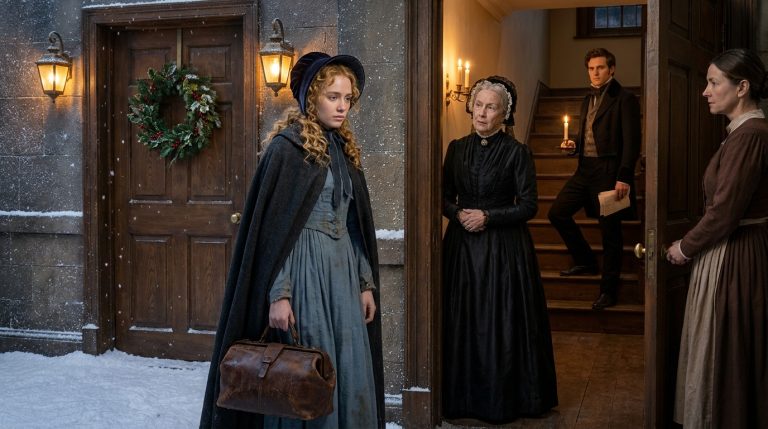
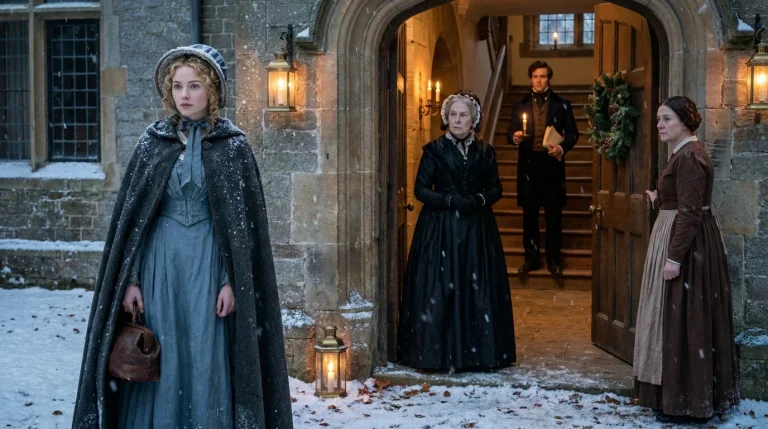
He counted them. Forty-one. He tried to remember when a crowd had last gathered to do him a kindness. He had to admit that none ever had. They had come for her.
He had thought that sending her away would be the hardest thing he did this year. He had not read the book. He had not seen the village. He had been a fool of the very first water, and he had not yet begun to pay for it.
The grain store smelled of dry barley, mouse, and a ledger kept honestly. It was the second morning, and Hester was counting sacks. She counted them every morning. Peg Hobbs held the tally stick, and Peg’s husband held his hat, and two dozen women stood in a patient line outside with baskets on their arms. The duke came in without a sound.
Nobody had warned the line. Peg Hobbs dropped the tally stick.
“Go on,” said Hester without turning. “His Grace is only here to look.”
“I am here to look,” said the duke.
He stood by the door with his hands behind him, and he looked for a full hour. He watched her weigh each portion twice. He watched her write each name, ask after each child’s cough, and write down the answer. He watched her refuse a sack to a man who had sold last week’s meal for gin, and give the same man a smaller sack for his wife instead.
“That is not in any rule,” he said afterwards.
“There are no rules. I made some.”
“May I see them?”
She handed him a sheet. It ran to eleven lines in a hand like a row of fence posts. He read it standing. When he gave it back, he had folded the corner down very carefully at the line about the widows.
“They are better than mine,” he said.
Nobody had ever said such a thing to her. She found, to her annoyance, that she needed a moment before she could answer. She could not sleep. At midnight on the second night, she went down for her father’s ledger, which she had left in the study, and found the muniment room lit. It smelled of burning paper and old oak.
The duke was at the desk in his shirtsleeves, writing, with a heap of scorched sheets in the grate. So that was what he had meant. He was burning the book. He was burning Tuck’s book and her tally and everything she had found. And in the morning, there would be no coal, no sum, and no duchess.
“You said you would leave the accounts alone,” she said from the door.
He did not turn.
“I said I would see to them.”
“By fire?”
“Those are my own letters,” said the duke. “They did not improve.”
She crossed the room because she did not know what else to do. The desk was covered with paper. At the top lay a lease, stamped and signed. She read it twice. A house in Bath in the name of Hester Corbold, tenant for life.
It was dated in January. She stood very still. His mother’s first letter had reached him in February. Garrow had told her so over the scuttles. The house in Bath had been taken a full month before anyone told him she was a spendthrift.
He had not come home to dismiss an extravagant wife. He had come home with the house already warm. The courtyard came back to her. The dusk, the saddle, the gloves he had not taken off. He had said it before forty servants and Mr. Tuck with his bright eyes and a curtain moving in the east wing.