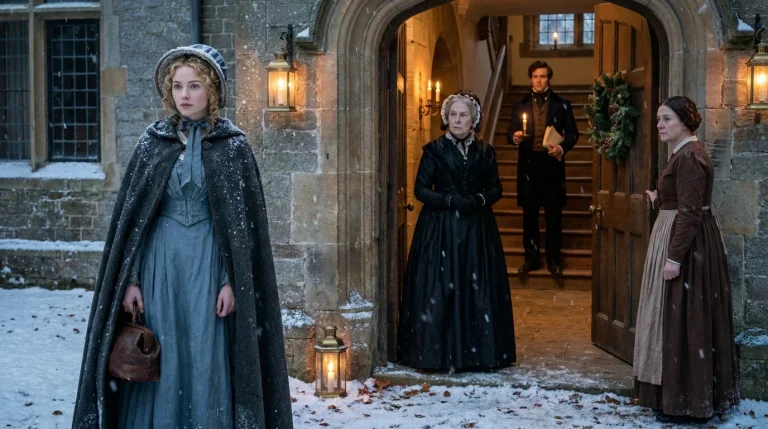
“And if it is not accounted for?”
“Then the tenantry will hear it read.”
He bowed.
“Publicly, Your Grace, so there can be no misunderstanding.”
The duke read the paper without a flicker.
“The dinner is in nine days,” he said.
“I am aware,” said Mr. Vane. “I have been very diligent.”
Behind him, the dowager looked at her son and, for one unguarded second, looked like a woman at a card table who has seen the dealer’s hand. That evening, Hester set her father’s ledger on the desk.
“I have found something,” she said.
She turned it over.
“Read it from the back.”
The great hall at Raisford Court smelled of woodsmoke, roast beef, and two hundred people trying not to look at one another. It was quarter day, and the dinner and the tenantry had come in their best coats. The long tables ran the length of the hall. Peg Hobbs from the village sat near the door with her husband, who held his hat in both hands. Mr. Penrose said grace and made it short.
The duke sat at the high table with his wife at his right and his mother at his left. Mr. Tuck stood by the door. Mr. Vane waited pleasantly for the pudding. When the plates were cleared, Mr. Vane rose.
“Your Grace, my lords, ladies, and good people, it is my painful duty,” he began, “to lay before this company a deficit.”
He unrolled a paper.
“The Hollisford Charity Trust, founded for the relief of the widows and the poor of this parish, stands short by forty-two hundred pounds. It is not a matter for ladies, and I beg the duchess’s pardon for introducing it.”
“It is a matter for this lady,” said Hester, “because I compiled the figures.”
She stood. The hall went silent. It was a complete silence, the kind in which a dropped pin would have sounded like a gun.
“Mr. Vane,” she said, “you have the deficit correct. You have the date wrong. It began eleven years ago under the late duke, and it was added to every year with his signature and with another.”
“Madam—”
“Let me finish. You are paid by the hour, I believe, and I am not.”
Somebody near the door made a noise like a man swallowing a laugh. Hester opened her father’s ledger.
“This is the private record of Mr. Brandreth, once treasurer of the trust, who resigned it rather than sign what he was asked to sign. He kept every withdrawal. I have read all of it.”
She read it. She read the sums and the dates and the signatures. She read the late duke’s name and then, beside it, the narrow slanting hand. She read the nineteen entries marked in her father’s careful pencil. Paid to Her Grace’s account: nineteen hundred pounds.
“The trust was short forty-two hundred,” she said. “The present duke has returned thirty-eight hundred and fifty of it from his own pocket, in secret, without asking this hall for thanks. That leaves three hundred and fifty.”
She turned a leaf.
“Her Grace the dowager took nineteen hundred from the trust itself. She has also taken thirteen hundred and sixty-two pounds from the coal and candles in six quarters through Mr. Tuck’s book.”
She turned another.
“Mr. Vane’s fee was sixty pounds, paid by this house. It was entered, I regret to say, under candles.”
The dowager opened her mouth. Nothing came out of it. Mr. Tuck had gone the color of tallow. Mr. Vane looked, for the first time, like a man who had been paid in advance for a house that had burned down.