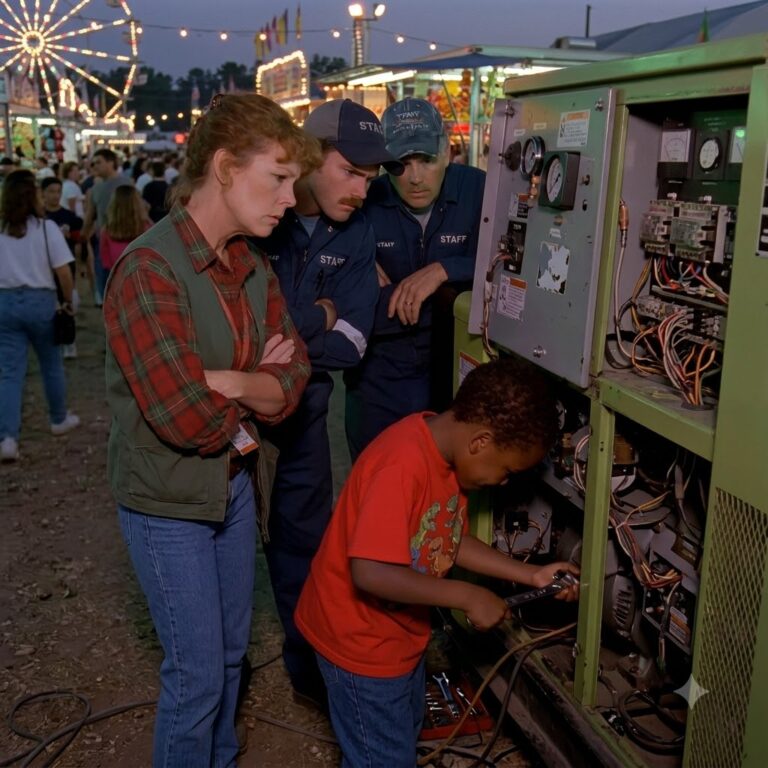
Their first design was crowded and confusing. Jordan tried to include every detail he had learned since the combine repair. A teammate asked whether he was building a tool or writing his entire childhood on a board. Jordan laughed, then removed half the labels. The simplified model became clearer to the youngest visitors.
A visiting farmer asked whether the tool would help with real maintenance. Jordan explained that it taught observation and safety awareness, not repairs on live equipment. The farmer said that distinction could help apprentices understand why careful records mattered. Jordan wrote the comment down. He had learned that accepting reasonable limits could strengthen an idea rather than weaken it.
The institute offered to test the board in three rural classrooms. The students had to prepare written instructions, safety guidance, and a budget. Jordan called Loretta to ask how she managed costs at the packing shed. She helped him estimate the materials and explain why donated labor should not be assumed to continue forever.
The classroom pilot worked, but the institute’s adviser said one important group of students still had not been consulted.
—
The missing group was the children of migrant seasonal workers who often changed schools during harvest months. Jordan knew several from the packing shed parking lot. They were used to arriving midway through a class and having teachers assume they could catch up alone. He asked whether the board’s lesson could be completed without knowing all the earlier terminology.
The new challenge felt different because people were no longer watching to see whether Jordan embarrassed himself. They were waiting to see whether his idea would stand up to the same scrutiny they would give anyone else’s. He was grateful for that ordinary fairness. No one could promise him the answer.
The team rewrote the instructions to begin with familiar examples: a bicycle chain, a kitchen fan, a toy wheel. They translated the key terms with help from staff who knew the students’ languages and tested the pages instead of assuming the translations were perfect. Jordan remembered Theo asking about his boots and insisted the materials never treated a student’s background as a defect.
During the pilot a girl named Rosa solved a model problem nobody else had noticed. Jordan asked her to explain her reasoning to the group, and she did so hesitantly at first. Her teacher later said it was the first time she had volunteered in science class. Jordan understood that the most important thing the project offered might be a reason for someone to speak.
The institute included Rosa’s observation in its evaluation report, with her name and her family’s permission. Jordan did not want the attention for himself. It was enough that the next classroom would have a better lesson because a young person had been heard.