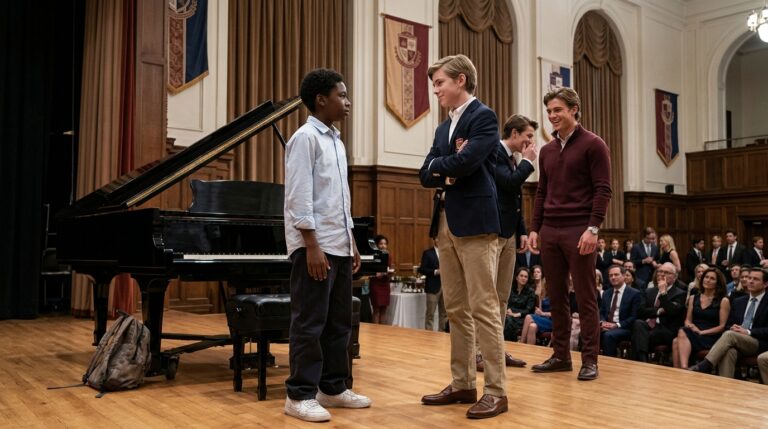
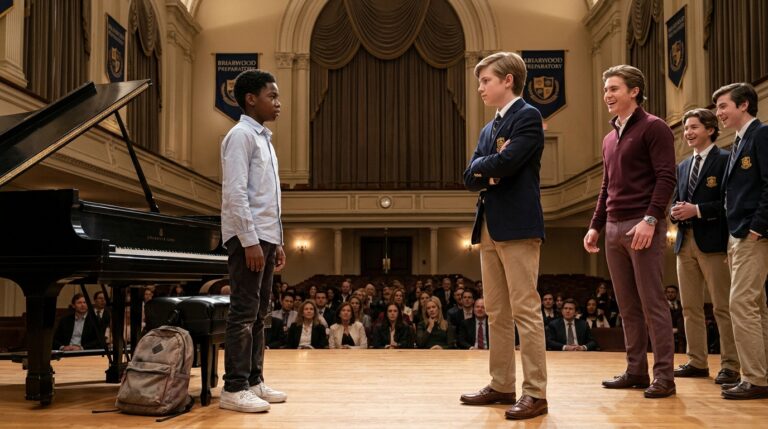
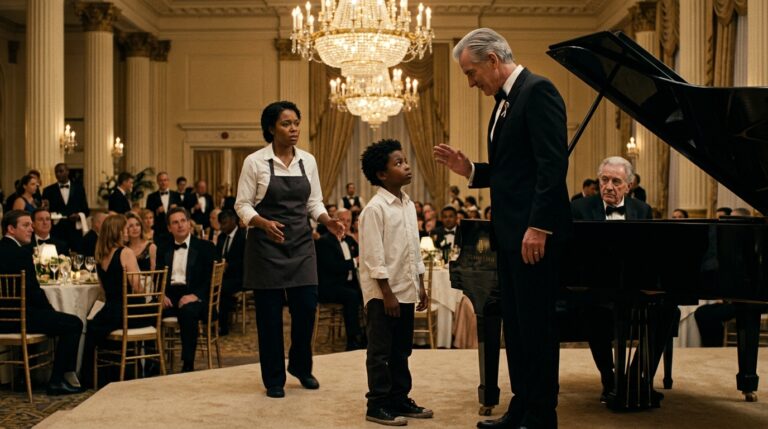
At the program’s final presentation, a growers association representative asked Jordan what he wanted to do after high school.
—
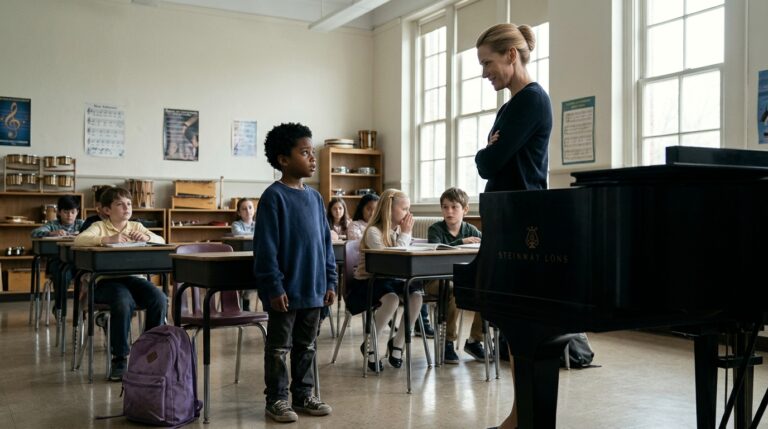
The classroom trial with children of seasonal workers did not go as smoothly as the team hoped. Several students had never used the technical words in the model, and one boy assumed that giving a wrong answer would make the instructor angry. Jordan recognized that fear. He asked the students to describe what they could actually see rather than guess what the teacher expected.
When the work finally moved forward, Uncle Ray stood back instead of stepping into the center of the attention. He had taught Jordan that knowledge is a thing to pass along, not a throne to defend. The boy looked around for Loretta, as he always did after something important. He did not interrupt her.
Rosa, the girl who had found the overlooked problem, suggested drawing the moving parts from the side instead of from above. The revised picture was clearer. Owen updated the digital version while Maya tested whether the new labels were easy to follow. Jordan watched the group change its design because of one student who had been quiet at first.
The institute teachers asked the team to record both successes and failures in the evaluation. Their first report had been too positive. Jordan admitted they had focused on the smiling children and ignored the moments when others became confused. The team added those observations and wrote down what had been changed in response.
Professor Shaw said a useful report was not a celebration. It was an honest account somebody else could learn from. Jordan remembered the combine repair log and saw the same lesson in a different room. He no longer needed every test to make him look clever.
The revised report was accepted, but the school district asked whether the teaching materials could be offered without charging students who changed schools midyear.
—
The team met with an education coordinator who explained that moving families often missed a school’s usual supply distribution. Some students arrived without notebooks or materials. Jordan asked what would happen if the model required a separate kit for every child. The coordinator said many would simply go without. That answer made him reconsider the design.
A good day can still contain an awkward conversation. Not everyone apologized in the words Jordan wished to hear. Some people offered a handshake and hoped it would erase the earlier cruelty. Others chose to stay silent. He decided he could accept practical cooperation without pretending the past had not happened. Even then, something about it felt different.
Maya suggested one durable classroom board with reusable pieces, plus individual paper worksheets that could be copied cheaply. Owen calculated the cost of the materials over several school years. Jordan asked the teachers which parts broke most often and redesigned the storage case so a missing piece would not end the whole lesson.