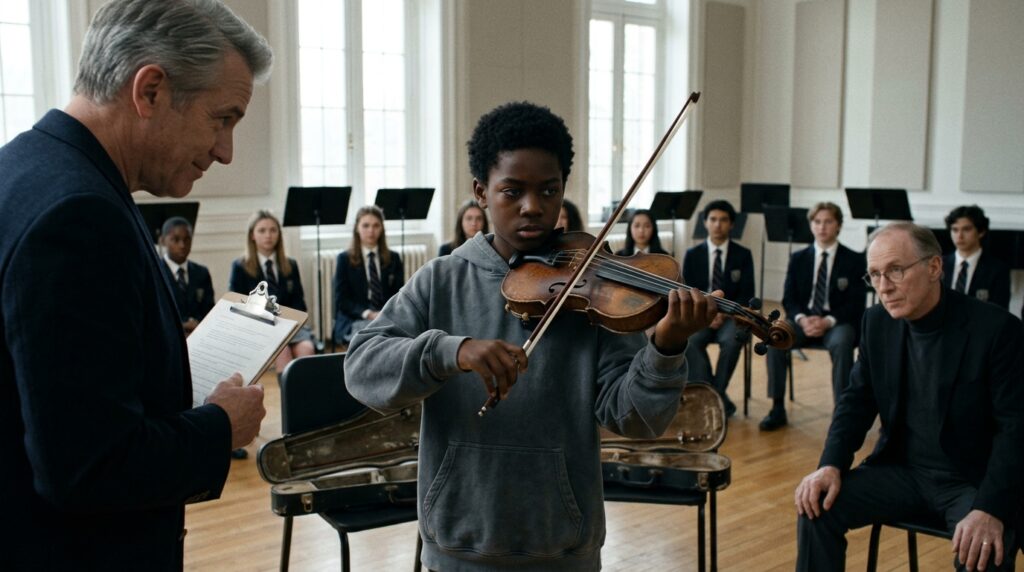
They Laughed When a Poor Black Boy Entered the Orchestra Audition — Then the Old Conductor Heard His First Note
The boy with the battered violin case had barely crossed the polished floor when a man at the judging table said, “This audition is for serious musicians, son.” Twelve-year-old Isaiah Reed stopped beneath the tall windows of Bellweather Conservatory, Philadelphia, 2026. Behind him, thirty young musicians sat with expensive instruments balanced across their knees. Several smiled at his gray sweatshirt and shoes with splitting soles. Isaiah had practiced what he would say, but the words deserted him.
“I brought the invitation,” he managed. Mr. Victor Harlan, chairman of the conservatory committee, looked at the paper without touching it. He had invited the city’s wealthiest families to observe the annual youth fellowship auditions, and he did not remember sending anything to a boy who arrived alone on the Number 23 bus. “Our preparation course costs more than the scholarship,” he said. “Are you certain you came to the correct building?”
A teacher in the second row quietly reached for her notebook, embarrassed that she had not challenged the first remark. The room was full of adults who taught children that courage mattered, yet most were content to watch one child face a public humiliation alone. Isaiah noticed the long scratches on the floor where music stands had been moved for decades. He knew the answer could change everything. Still.
Isaiah lowered his case. The zipper had been repaired with blue thread. His grandmother had put it there after the original fastening broke. In the front row an elderly orchestra director, Leonard Bell, lifted his head. He had been silent throughout the morning. Isaiah knew nothing about him except that he was famous and looked tired. Harlan pointed toward the exit. Then Leonard asked a question nobody had expected: “Who taught you to carry that violin like somebody’s life depended on it?”
Three days earlier, Isaiah had stood in his grandmother’s kitchen while rain ran through the ceiling into a soup pot. The apartment was above a shuttered barbershop in North Philadelphia, where buses growled past the windows long after midnight. His grandmother, Ruth Reed, worked the breakfast shift at a nursing home and cleaned offices twice each week. She had never claimed their life was easy. “Easy isn’t the same as worth having,” she often told him, reaching for her coat before dawn.
The violin belonged to Isaiah’s grandfather, Samuel, a church musician who had died four winters earlier. Samuel could make a hymn sound as though it held the memories of every person listening. He taught Isaiah to listen before moving his fingers, to hear the spaces between notes, and to finish every phrase with care. Ruth had kept the instrument after funeral expenses swallowed their savings. Its varnish was rubbed pale where Samuel’s hand had rested.
Ruth counted cash in a chipped sugar bowl after dinner. She set aside bus fare first, then enough for bread and eggs. Isaiah pretended not to watch because he knew she hated being pitied. He helped wash dishes and laid out his schoolbooks beneath the only lamp that worked reliably. That evening, neither of them slept easily.
That afternoon a letter came from Bellweather. A volunteer had heard Isaiah playing in a neighborhood library, recorded his name, and urged him to apply for the fellowship. The printed invitation offered a full scholarship and private instruction to one remarkable student. At the bottom, in smaller type, it demanded a seventy-five-dollar registration deposit. Ruth read that line three times. Their electric bill was already overdue. Then Isaiah noticed a handwritten message on the reverse of the invitation, signed by a person neither of them knew.











