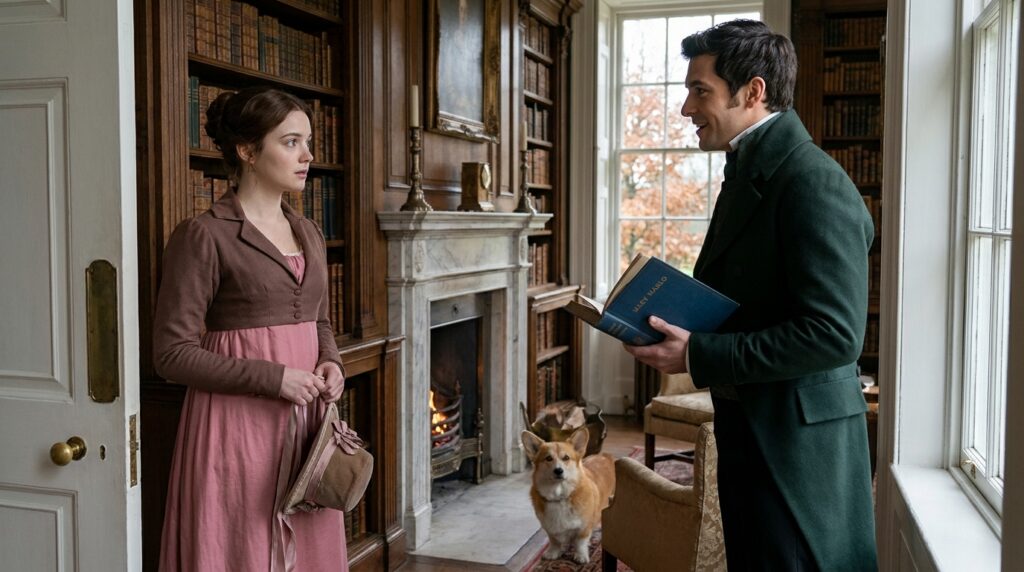
The newspaper came up from Devizes on the Thursday coach, and by 9:00 it was lying open beside her father’s plate, folded back to the page he wanted. He tapped it with his knife. He tapped it again in case anyone at the table had missed it. Then he read it aloud, slowly, the way a man reads out a horse race he has already won. “A marriage had been arranged and would shortly take place between Walter, Duke of Shelford of Old Moore in the county of Wiltshire, and Miss Sophia Penham, only daughter of Mr. Penham of the same county.” He set the paper down and looked round at them all as if he had written it himself.
In a way, he had. Sophia said nothing. She buttered her toast. Her father did not expect her to say anything, and she had found long ago that it was easier not to disappoint him in that particular. She was 23, and she was wearing her everyday gown of soft rose pink, which had been let out once and taken in twice, and she sat where she always sat, at the end of the table nearest the window.
From there she could see the whole room without anybody seeing her. It was her favorite seat in every house she had ever entered. When her father rose to go and tell the stables, she drew the newspaper towards her across the cloth. She did not look at her own name. She looked a little lower down the same page at a small square notice set in plain type between an advertisement for gloves and another for a cure for gout.
It said that a new novel by the author of the Marlo sisters would be published in London at Michaelmas in three volumes and might be ordered from every good bookseller in the kingdom. It said the novel was by a lady. It did not say which lady. It never did. Sophia read the notice twice.
Then she folded the paper so that her father’s page lay on top again, and she went on with her toast. Her hands were quite steady. Nobody at that table knew it. Nobody in that house or in the whole county of Wiltshire knew that the lady was sitting at the end of the breakfast table in a gown that had been let out once and taken in twice. And if Sophia had anything to do with it, nobody ever would.
She had written the Marlo sisters at 19 in the little room at the top of the house where the roof sloped down so low that she had to sit on the floor to reach the window. She had written the second at 21 and the third, the one that was to come out at Michaelmas, through the whole of the past winter with her shawl round her shoulders and her ink kept warm in her lap. Each of them had sold well, and the Marlo sisters best of all; it had been talked of in every drawing room in London. People quarreled over it at dinner. Ladies read it aloud to each other in Bath.
A bishop had preached against it, which had done it no harm at all. Everyone, it seemed, wanted to know who had written it, and everyone had a guess, and not one of the guesses had ever come within 50 miles of the Penham breakfast table. That was exactly as it ought to be. Sophia was the dull Miss Penham. She had heard herself called so at the assembly rooms in Salisbury by a young man who did not know she was standing behind the curtain, and she had not minded half as much as he would have expected.
She did not talk much in company. She did not sparkle or flirt or play the harp. She sat in corners and listened. She watched how people held their teacups when they were lying, and which ladies laughed a moment too late, and how a proud man’s voice went thin when he spoke of money. She remembered all of it.
Then she went home and put it in her books, with the names changed, and the edges softened, and London paid her for it. London paid her a great deal. That was the other half of the secret and the heavier half. Her father was a vain and cheerful man who had never in his life spent less than he wanted to, and over the years the house had grown shabby around him without his noticing. The cook had gone unpaid for a whole summer once.











