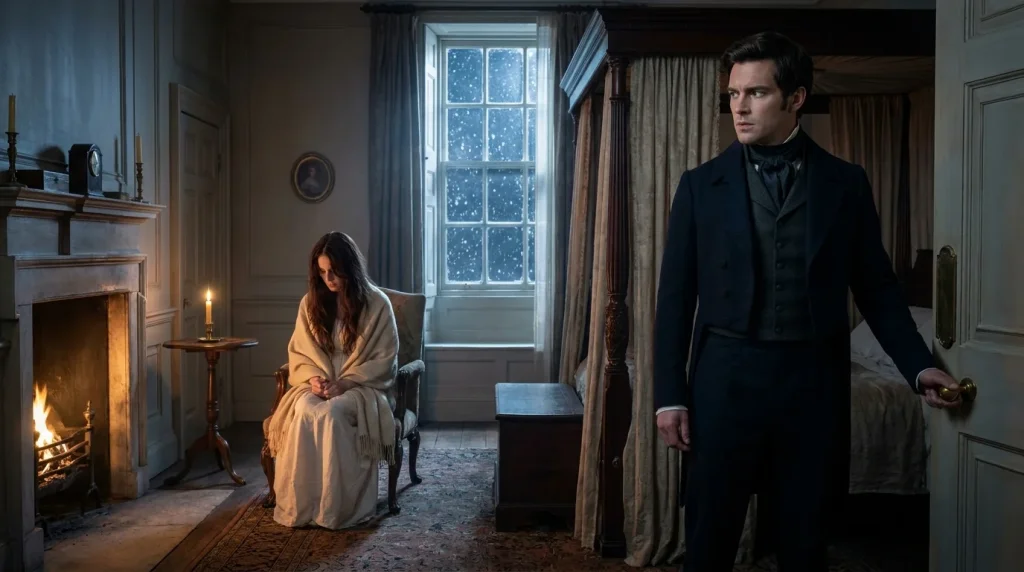
On his wedding night, William Hawthorne, the Duke of Ravenshire, stood frozen before a bedroom door in the icy corridor of a snow-buried house. That very morning, he had married the woman all of Yorkshire called the ugliest girl in the county. No one would describe her face to him. His own cousin had only laughed and told him not to expect anything pleasant beneath the bride’s veil. Now, as William pushed the door open, his new wife sat trembling beside the fire, and then she looked up.
The winter of 1816 came early to Yorkshire, and it came without mercy. Snow fell for days on end over the old stone towers of Ravenshire Hall, burying the gravel drive, softening the hard edges of the battlements, and piling against the tall windows until the house seemed to sink into a sea of white. In the west wing, the corridor was nearly dark. Only a few candles burned in silver holders along the wall, their flames bending each time the wind found a gap in the ancient glass. William Hawthorne stood before the door of his new wife’s bedchamber and did not move.
One hand rested on the brass handle, so cold it seemed to burn his palm. His left leg ached, as it always did when the weather turned bitter, a deep throbbing pain that reached from his knee to his hip and reminded him every winter night of the mud and smoke of Waterloo. He was thirty-one years old. He had marched through French cannon fire. Yet here, in the silence of his own house, a single bedroom door made him hesitate.
That morning, in the frozen chapel on the edge of the estate, he had married Antoinette Whitcomb. The nobility of Yorkshire had a name for her, whispered behind fans and over card tables for years. They called her the ugliest girl in the county. No one he asked would describe her face, and those who tried only shuddered politely and changed the subject.
Throughout the ceremony, she had worn a thick gray veil that fell past her chin, and she had kept her head bowed so low that William saw nothing of her but the trembling of the cloth with each breath. When Reverend Price asked whether she would take this man as her husband, her answer was so quiet that William barely heard it. Then, as they bent over the parish register to sign their names, his cousin Caroline had leaned close to his ear, her golden curls brushing his shoulder.
“Dear cousin,” she had whispered, “do be kind to her. Before you, no man has ever been brave enough to look at her for very long.”
She laughed softly behind her silk fan. William had not answered. He had only looked across the cold chapel at the small, bowed figure of his bride, and something in the stillness of her shoulders had stayed with him all day. Now he turned the handle and stepped inside. The room was small and plainly furnished.
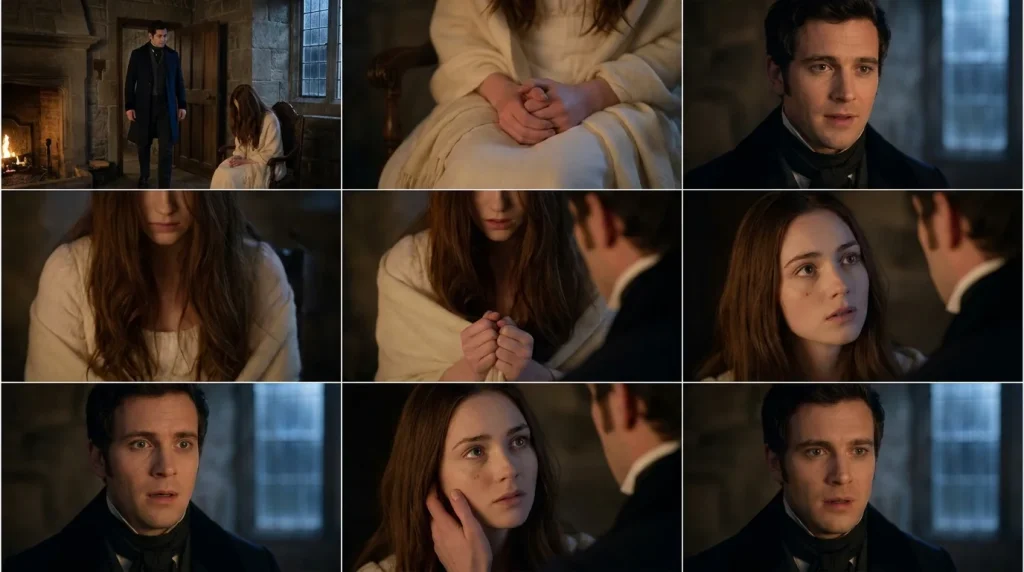
A weak fire flickered in the grate, giving more smoke than heat. Antoinette sat in a worn armchair beside it, dressed in a simple white nightgown with a woolen shawl pulled tight around her shoulders. Her brown hair fell loose and heavy, curtaining almost all of her face. Her hands were clasped tightly in her lap, and William saw that they were shaking. He stopped several steps away, careful not to come closer.
“Miss Whitcomb,” he began, and then caught himself.
She was his wife now.
“Forgive me, Your Grace. I only came to wish you good night. I won’t trouble you tonight.”











