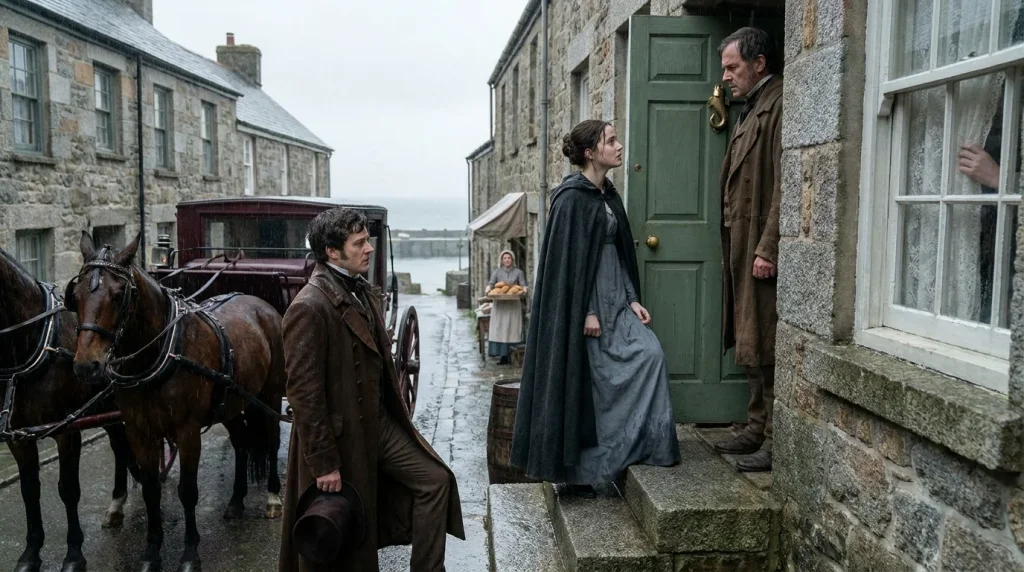
“There is no room for you in this house,” said Josiah Treloar, and he shut the door.
The bolt went home on the inside. Cecily Treloar, six and twenty, stood on her father’s step in the rain with her bonnet strings soaked through. She had come 300 miles to stand there. It had taken 11 days. It had taken 11 seconds to be sent away again.
She had expected coldness. She had expected her stepmother at the parlour window and a lecture about the Bath newspapers and a damp bed over the washhouse. She had not expected the door. The street had expected it. Porthkellis was one steep street of granite cottages running down to a harbour, and every cottage had a window.
Every window had a face in it. Mrs. Hawkins at the bakehouse had stopped with a tray of loaves against her hip. Behind her father’s own parlour glass, the lace curtain had been drawn aside by four inches and a pale hand held it there. Her stepmother, Loveday Treloar, had always known exactly how much of a thing to show. The whole street was waiting for the companion from Bath to sink down on the wet granite and weep.
Cecily did not weep. She had not wept since she was 14. That was the year her mother’s coffin went down this same hill in the rain, and her father walked ahead of it without taking her hand. She had decided then that the rain could weep for both of them. It was doing so now, steadily down the back of her neck.
She looked at the door. Green paint and a brass knocker shaped like a fish.
“Miss Treloar.”
The voice came from behind her, low and level, out of the rain. Ambrose Loxley, eighth Duke of Penhaligon, stood at the bottom of her father’s three granite steps with his hat in his hand. The rain ran off his hair and into his collar, and he did not seem to notice it. He was tall and narrow, built like a riding whip. His hair was the color of dry sand, graying above the ears, though he was not yet 40.
His face was weathered brown, the face of a man who stood on cliffs on purpose. His eyes were green, not a soft green, the green of deep water off a granite ledge where the sea goes cold all at once. Cornwall said he had put his own wife out of doors one winter and that she had died of it. Looking at him in the rain, Cornwall found it very easy to believe.
“I said I would see you home,” said the Duke. “I have seen you to the door.”
“So you have, Your Grace.”
“It is shut.”
“I had noticed.”
He looked at the green door for a long moment. Then he put his hat back on.
“Then you will come to mine,” he said.
At the bakehouse, a loaf slid off Mrs. Hawkins’s tray and into the gutter. Nobody picked it up. Cecily turned on the step.











