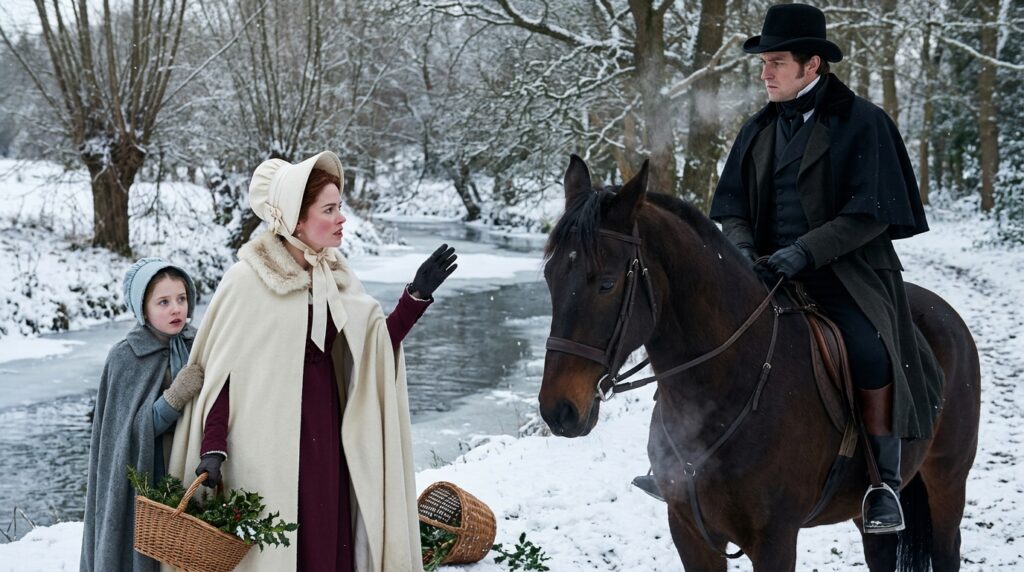
“She promised, Richard.” His mother said at the moment the drawing room door closed behind them, as though she had been holding it in the whole drive home from church. “I heard her mother.” He said. “And you say it as though you have known her for years, and were praying she would say yes.” She looked me in the eye and said, “I promise, ma’am.” And then she looked at you as though she would rather have promised to walk into the sea. Catherine Fenwick sat down and began to draw off her gloves, finger by finger, smiling to herself. “I liked her the moment I saw her.
There is not one ounce of pretense in that girl. Do you know how rare that is?” Richard did not sit. He went to the window instead, and stood with his back to her. “Mother, that is the woman I told you about last night.” “Which woman?” “At the stream. The one who stood in the water and told me my horse could not drink from my own river.” There was a short silence behind him.
Then, “Miss Lamb.” “Miss Lamb?” “The rude one, the one who shouted at you.” “The very same.” He heard her set her gloves down on the table. “Well,” she said slowly, “she did not sound very rude to me this morning. She sounded honest, and if I remember rightly, Richard, the reason she shouted at you was that you had frightened a child half to death.” She paused. “I find I like her even better.” He turned round. His mother was watching him with an expression he knew far too well.
It was the one she had worn when he was 9 years old, and swore he had not been near the jam. “I have watched you meet a great many young women over the years.” She said gently. “I have never once seen one put you out of temper in under a minute.” “She did not put me out of temper.” “No, of course not. I came here to find a sensible wife.” He heard his own voice harden, and could not stop it. “A quiet woman who will keep my home and be content in it.
Not a woman who makes scenes in churchyards, and stands in rivers shouting at strangers.” “Your father used to say much the same thing.” Said his mother, about the kind of wife he wanted. The room went very still. “Do not,” said Richard, “compare me to that man.” He had not seen Edmund Fenwick in 8 years, and if God was kind, he would never see him again. But he could still see him whenever he closed his eyes. His father coming home at dawn with his cravat undone, and the smell of some other woman’s perfume on his coat.
His father at the breakfast table, cheerful as a schoolboy, while his mother sat across from him, pretended for the servant’s sake that she did not know. Richard had watched her pretend for 25 years. He had watched her grow quieter every one of them. He crossed the room and sat down beside her, and took her thin hand in both of his. “Stay here,” he said.
“This house is yours, all of it. I bought it for you. You never need go back to him.” “Richard, we have spoken of this.” “Then let us speak of it again, and again, until you say yes.” She only smiled and touched his cheek, and said nothing at all. She never did. There was a knock at the door.
Hobbs, the butler, came in with a letter on a silver tray. “Beg pardon, sir. A groom brought this to the kitchen door this morning while you were at church. He would not stay.” Richard took it, glanced at the writing on the front, and went very still. He knew that hand.
He had known it since he was a boy. He did not open it. He did not even break the seal. He got up, crossed to the fireplace, and dropped it into the flames. And he stood there watching until every corner of it had curled black and fallen away.
Then he turned back to his mother, and his voice was perfectly calm. “Shall I ring for tea?” He did not see his mother’s face as the letter burned. If he had, he might have wondered why she looked so afraid.
Across the stream, the Lamb House knew nothing of letters or fires. It had heard of nothing all evening but the ball. “Did you see his face when the vicar said dropped dead?” Caroline was curled in the window seat with her knees drawn up as she had been since supper. He did not move. Not once.
“I have never seen a man sit so still in church. You were not supposed to be looking at his face, said Augusta. You were supposed to be listening to the sermon. 40 minutes of Mr. Gibbs about people falling over. I would far rather have spent it looking at Mr. Fenwick.
Caroline sighed. Those shoulders, Augusta, and the way he walked up the aisle as if he owned the whole church. He very nearly does, said their mother from her chair by the fire. Mrs. Hollis says he has bought the Halsey farms as well. Augusta, you will wear the new gloves tomorrow.
And Caroline, you will not giggle. Gentlemen of fortune do not marry girls who giggle. Sarah sat at the far end of the sofa with her book open on her knee and tried to read the same page for the fourth time. And you, Sarah, said her mother without looking round. The headache you did not have in front of his mother.
I thought I should die where I stood. Then it is lucky you did not tell a lie about it, Mama. Or you might have. Caroline giggled. Augusta did not.
Augusta waited until their mother had gone up and Caroline after her still humming. Then she crossed the room and sat down beside Sarah and folded her hands in her lap the way she did when she had rehearsed something. Sarah, about tomorrow. I promised his mother I would go. I cannot take it back now.











