The notice was nailed to the church gate at Calverstone on the morning of the 14th of April 1817, and by noon every soul in Wiltshire had read it twice.
“100 pounds to any person who can sit the Duke’s black stallion unharmed before the 1st of May.”
11 gentlemen had already tried that week, and all 11 had walked into the stable yard with a boast and walked out without a word. 100 pounds was 3 years’ wages for a governess. It was a fortune. And the Duke of Calverstone, 33 years old and the coldest man in the county, had signed the notice with a hand that did not look steady.
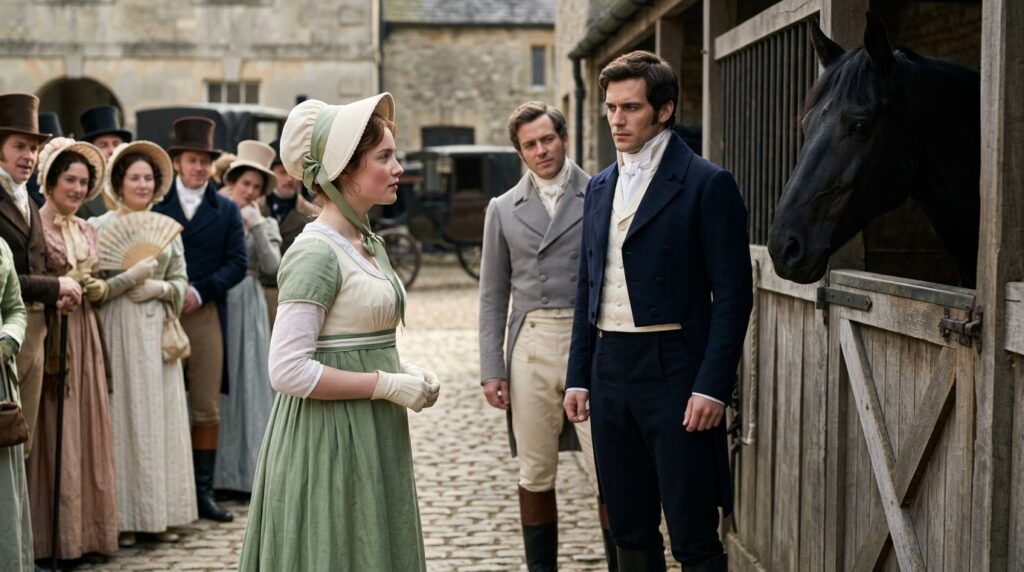
By 10:00 the yard was crowded. Gentlemen leaned on the fence with wagers in their pockets, and ladies had driven out in their carriages for the entertainment. Everyone knew how the morning would end, though nobody could have explained why they were so eager to watch.
Then a woman stepped out from the back of the crowd, and the laughter began before she had spoken a word.
Miss Harriet Penrose was 29, the daughter of a dead parson, and for 3 years the county had spoken of her in the soft voice people reserve for funerals. In the summer of 1814, at the Salisbury Assembly, the man she had expected to marry had stood before 200 guests and called her too plain, too odd, and fit only for the stable. Nobody had answered him, not the matrons, not the gentlemen, and not the young Marquess of Renford who had stood in the doorway that night with his eyes fixed on the floor. That Marquess was the Duke now. He watched her cross the cobbles from the stable door.
“I will try,” she announced.
A baronet’s wife covered her mouth. Someone near the fence called out, “Go home, Miss Penrose, before you shame yourself further.”
The laughter swelled and rolled across the yard. Harriet did not look at any of them. She owed 86 pounds to an apothecary and a corn merchant for her father’s last illness, and she had until midsummer to pay it or lose the only home she had ever known. Pride was a luxury she had stopped affording long ago. Lord Percival Garrow, the Duke’s cousin, stepped forward with a smile as smooth as warm butter.
“Alexander, surely you cannot permit this. The lady is hardly equal to it.”
“The lady has not been refused,” the Duke replied slowly.
“Then let me spare you the trouble.”
Garrow’s voice dropped into something that sounded almost like kindness.
“Put the animal down. One shot, and it is finished. Your father would have wanted it. That horse is the reason he lies in the churchyard.”
The Duke flinched as though struck, and for one moment he looked like a man being dragged back into a grave. Harriet answered for him.
“He did not kill anyone, Lord Garrow.”
Every head turned.
“I have stood at that fence for 10 minutes,” she went on, perfectly calm. “He is not wild. He shies only when a hand passes near his shoulder, and he does it the way you pull your fingers from a fire. That is not temper; that is pain.”











