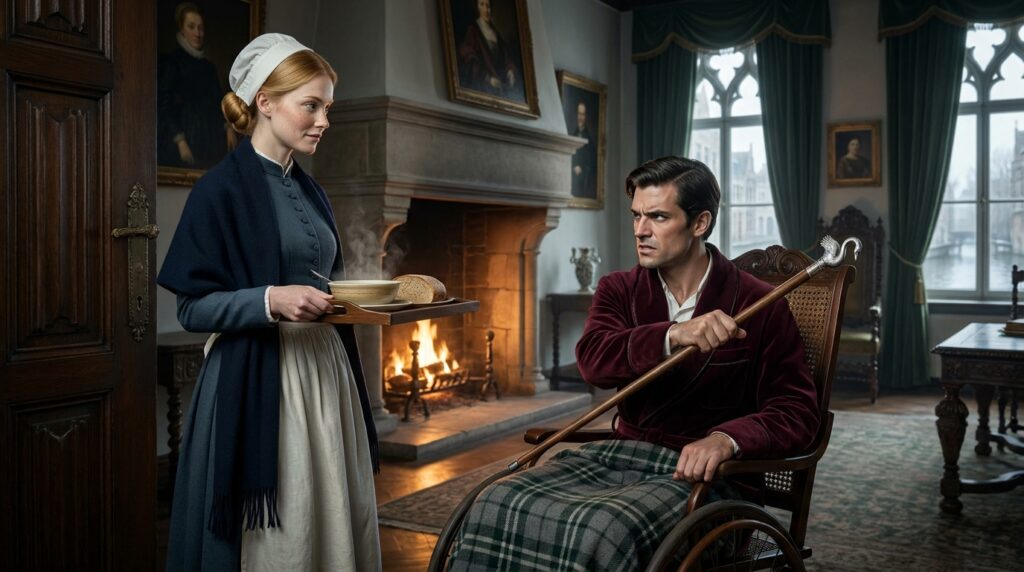
No Doctor Could Make the Duke Walk Again—Until a Humble Cook Discovered His Secret
Seven doctors had climbed the stairs of the north wing of Hof Svaneveld in two winters, coming from Bruges, Ghent, and Brussels. All of them had come down with the same verdict: The duke would never walk again.
Floris van Svaneveld, thirty-six years old, lived locked in a room with closed curtains, trapped in a wicker and mahogany chair, throwing trays at anyone who dared to go up. But on a humid night during Lent, next to the iron stove that crackled amidst clouds of broth steam, a widowed cook washed the tonic glass that came down from his room and sensed in the bottom of the glass a bitterness she knew from another life. What Nele Walters was about to discover in it would change the entire house. This is a story about how the woman everyone called a bad omen was the only one capable of seeing a man who already wanted to stand on his own feet.
Bruges, in February 1879, looked like a tired lady who had fallen asleep sitting by the water’s edge. It had been a long time since the port had closed to large ships, and the city lived on memories: the still canals of an almost black green, the stepped roofs covered in mist, and the bells that marked every quarter hour without any rush. On the thresholds of the narrow houses, the lacemakers were already sitting with their pillows on their laps, and the small clicking of the bobbins rose through the streets like fine rain on tiles. They worked for pennies with shawls on their shoulders and fingers purple from the cold, weaving for the ladies of Paris a lace that they themselves would never wear. On the canals, white swans glided under the stone bridges.
It was over one of these bridges, the Groenerei, that Nele Walters passed on that foggy morning carrying a linen bundle and, tucked against her chest, a letter of recommendation signed by the beguines. She was thirty-one years old. Her honey-brown hair, straight and thick, was tied in a low bun under a white linen cap, and a few stubborn strands escaped at the nape of her neck. Her eyes were greenish-gray, the same color as the water that ran beneath her, calm and attentive, like those of someone who had spent her life watching over pots. There were light freckles on her nose and small, old marks from oven burns on the backs of her hands.
She wore slate-gray wool with tight sleeves, a raw linen apron, and a dark blue shawl crossed over her chest. She walked straight and silent, like someone who had learned not to take up space. But there was one thing she never did, no matter how much life insisted: she never lowered her eyes when spoken to.
And that morning, by the bridge, a fishmonger with red hands stopped scaling a herring and whispered to her neighbor, loud enough to be heard.











