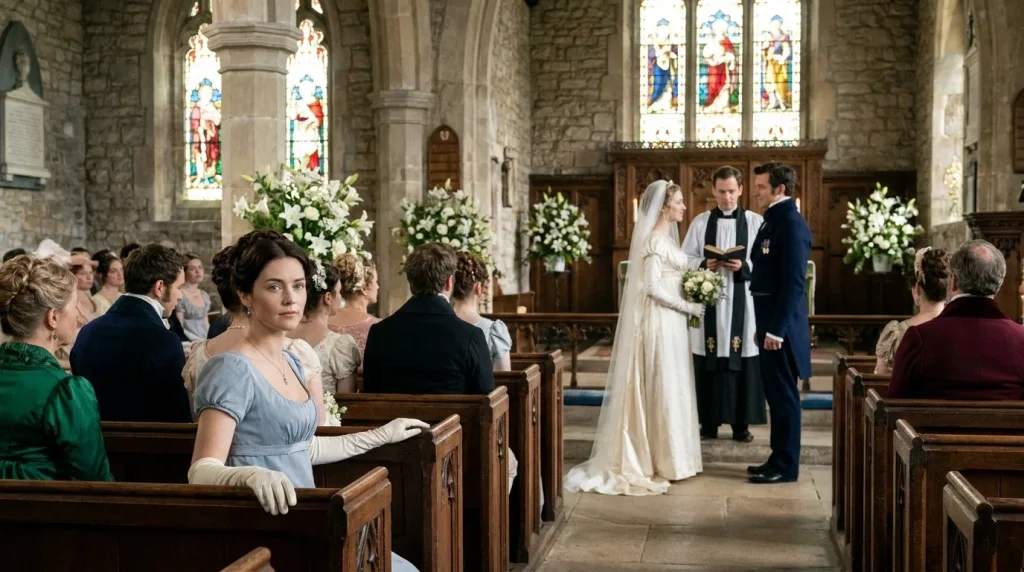
“If any person here present knows any just cause why these two may not be joined together in holy matrimony, let them speak now, or else forever hold their peace.”
In two hundred and eleven years, no one in the Church of St. Margaret at Ashcombe had ever answered those words. Brides had wept through them. Grooms had yawned through them. One elderly bishop had famously paused in the middle of them, closed his eyes for a short and peaceful nap, and finished the sentence when he woke. But no one in all that time had ever stood up.
On the last morning of April, three hundred guests filled the pews to watch the Duke of Ravensmore marry the Earl of Halvering’s only daughter. They came in silk and feathers and borrowed carriages. They came to see the war duke, the man who had held a burning ridge in Spain for nine hours with half a regiment and a broken sword, finally surrender to something as ordinary as a wife. And when the vicar spoke those words, Miss Lydia Marsh, the vicar’s own sister, rose from the third pew. Three hundred people held their breath.
By nightfall, every one of them would agree on exactly what she had wanted. Every one of them would be wrong. It had begun three days earlier with a bucket of lilies and a girl who could not stop crying. Lydia Marsh was twenty-six years old, unmarried, and, in the opinion of the parish, entirely too fond of saying things out loud. She kept house for her brother Thomas, mended the altar cloths, taught the village girls their letters on Tuesday afternoons, and had never once in all her life managed to keep a true thing inside her mouth when it wished to come out.
Her late mother had put it best.
“Some girls are born with a needle, Lydia, and they spend their lives quietly stitching things together. You were born with a bell.”
It had not been meant as a compliment. Lydia had decided to take it as one anyway. On that gray Thursday afternoon, she stood in the empty church with her sleeves pushed to the elbow, wrestling white lilies into brass urns that had been designed, as far as she could tell, by someone who hated flowers. The wedding was in three days. The duke’s aunt had sent instructions in a letter four pages long, and every page ended with the words, “Nothing less will do.”
The door at the back of the church opened. A young woman stepped inside, slender and fair, wrapped in a pale gray pelisse that cost more than the vicarage roof. She did not genuflect. She did not look at the altar. She looked at the aisle, the long stone aisle she would walk down on Sunday, the way a soldier might look at a field he had been ordered to cross.
Lydia knew her at once. Everyone in Ashcombe knew her. Lady Cecily Dunmore, nineteen years old, the bride.
“Forgive me,” Lady Cecily said. “I only wished to see it.”
“Of course,” said Lydia. “It is a very good aisle. Long, reliable. It has never once collapsed under a bride.”
Lady Cecily tried to smile. Then her face folded in on itself quietly and completely, and she sat down on the nearest pew and began to cry. Lydia put down the lilies. She had comforted crying girls before: girls with broken slates, girls with sick mothers, girls whose sweethearts had gone to sea. She knew that the worst thing one could do was ask what was wrong too quickly.











