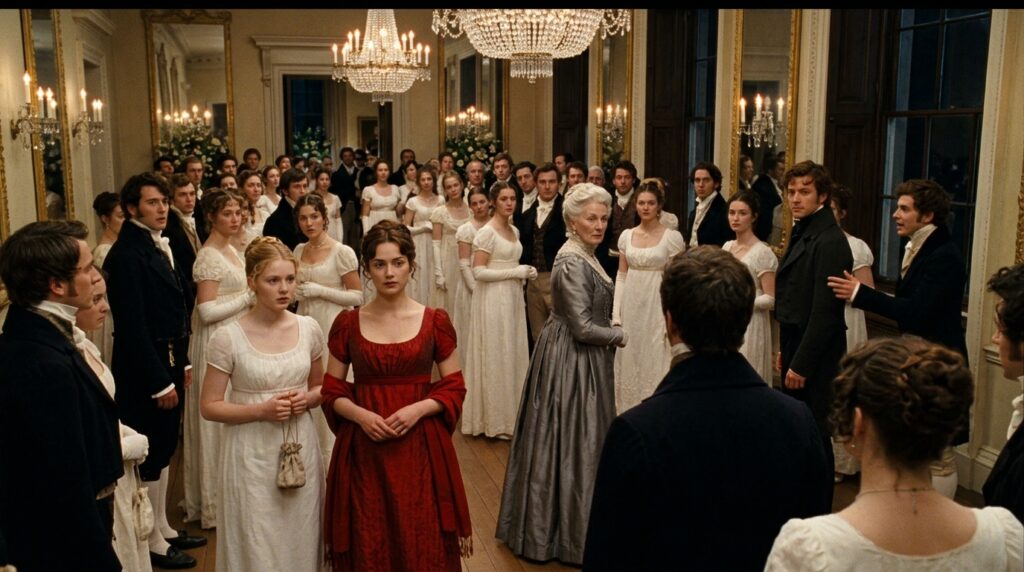
The talk did not stop all at once. It stopped in a ripple, spreading out from the door the way a ripple spreads on a mill pond. Heads turned, fans paused. A girl near the door said:
“Oh.”
Quite loudly, and her mother put a hand on her arm. Alma felt the silence go across the room ahead of her and arrive at the far end where it struck something and came back. She did not look down. She did not look at anybody. She walked Thea to a place against the wall where there were two empty chairs, and she sat down, and she folded her gloved hands in her lap.
The dowager was standing near the head of the room. She was a tall woman, very straight, perhaps 60, in a gown of dove-colored silk, with a high collar of old lace. Her hair was white and dressed close to her head. She had the kind of face that had been beautiful once and had decided at some point that beauty was not useful enough to keep. She turned and looked at Alma across the length of the floor.
It was not a long look. It did not need to be. Then she said something to the woman beside her. A thin woman in plain black, and the woman in black looked at Alma, too.
Her expression was not anger. Alma could not read what it was. Across the room by the windows that opened onto the terrace, a group of gentlemen had stopped talking. One of them, a fair young man with a high collar and a loud voice, began to laugh.
“Rookhope,” he said, and his voice carried the way loud voices do in a quiet room. “Look there. Your 50 guineas just walked in on two feet.”
A few people laughed with him uncertainly. Most did not. The man beside him did not laugh at all. He was tall with chestnut hair that would not lie flat, and he was dressed more plainly than anybody else in the room. He had been looking out of the window at the sea.
Now he turned his head and looked at Alma. She understood two things at once. The first was that this was the Duke. The second was that there had been a wager, and that somehow by walking through the door in a red gown she had made with her own hands, she had become part of it.
She felt the heat climb into her face, and she hated it. She kept her eyes on the floor in front of her and listened to the music begin again, and the talk come back slowly, like water filling a footprint in sand. Beside her, Thea whispered, “Alma,” in an anguished voice. Alma said:
“Hush! It is nothing to do with us.”
But the Duke was crossing the room. He crossed it the long way down the middle of the floor between the dancers without hurrying. People moved out of his path. He stopped in front of the two chairs and bowed first to Thea and then very slightly longer to Alma. He had hazel eyes, more green than brown in the candle light, and a face that looked as though it did not smile often, and was not sure it remembered how.
“Miss Winton,” he said.
He had got her name from the footman. Then:
“Will you dance?”
“I am not here to dance, Your Grace. I am here as my sister’s chaperon.”
She said it quietly and clearly, and she was pleased that her voice did not shake.











