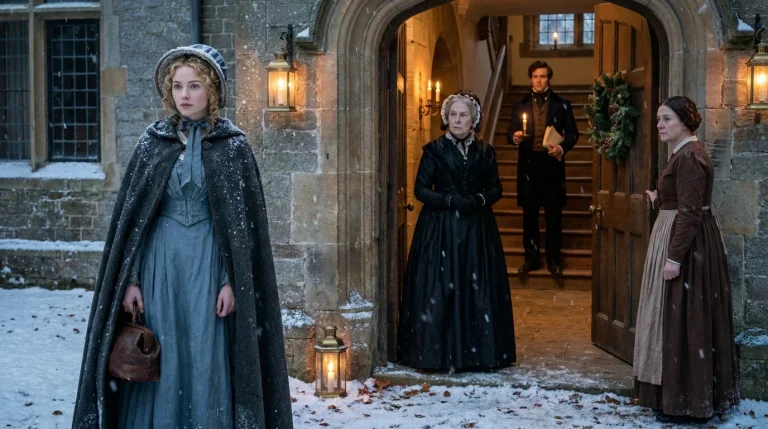
A Different Household
Clara moved out of the main mansion and took rooms in a smaller house near the ironworks. She kept the library books, her father’s papers, and the portrait of the workers who had founded the relief fund. She did not want to live among the rooms where she had been watched and controlled.
Thomas offered to find her a companion, but Clara said she wanted to learn how to live without every choice being arranged by someone else. She hired a housekeeper on fair wages and made her own schedule. At first, the freedom felt unfamiliar. She would stand at a window and wait for someone to tell her what came next.
The habits of control did not disappear because Henry was gone. She still apologized before asking for help. She still checked the hallway before speaking. A physician who treated her after the hearing explained that fear could remain in the body long after the immediate danger ended.
Clara began visiting the school attached to the mill and reading to the workers’ children. She did not tell them to be brave. She told them to learn their rights and keep copies of important papers.
Thomas returned to his army pension office and helped veterans apply for benefits. Their friendship continued, but neither tried to turn the rescue into a romance. Clara needed time to understand what she wanted, and Thomas respected that.
For the first time, affection did not arrive with a demand.
The Last Conversation with Henry
Months later, Clara received a letter from Henry in prison. He asked her to visit. She considered refusing, then decided to go with the solicitor present. She wanted to hear whether he understood what had happened, not because she expected an apology to repair the marriage.
Henry looked older and thinner. He said he had been misled by his mother and Rook. Clara replied that he had still chosen to hurt her, forge the medical report, and use the trust money. He said he had been afraid of losing the estate.
Clara asked whether he had ever considered what the widows had lost. Henry said he had intended to repay the money. She asked whether he had intended to return her freedom as well.
He had no answer.
Before leaving, Clara told him the marriage was over. She would not visit again unless there was a matter concerning the legal settlement. Henry asked whether she still loved him. Clara said she no longer knew the man she had married, and she would not spend the rest of her life searching for him inside the person he had become.
She left without anger. Outside, Thomas waited by the carriage. He did not ask what Henry had said. He simply offered his arm.
Clara accepted, not as a woman being rescued, but as a woman choosing the company she wanted.
The School at Mill Crossing
The ironworks trust funded a small school at Mill Crossing for the children of workers and the families of widows. The building had two classrooms, a library, and a warm kitchen where no child was turned away at lunchtime. Clara insisted that the school publish its accounts every quarter.
Ada Mercer became one of the trustees. She knew what it meant to depend on a payment that might never arrive. Her questions were practical and sometimes uncomfortable, which was exactly why Clara wanted her on the board.
Thomas arranged for returning soldiers to teach mathematics, mechanics, and reading. Some had lost work after the war and needed a place to begin again. The school became a meeting place for families who had once been isolated by debt and shame.