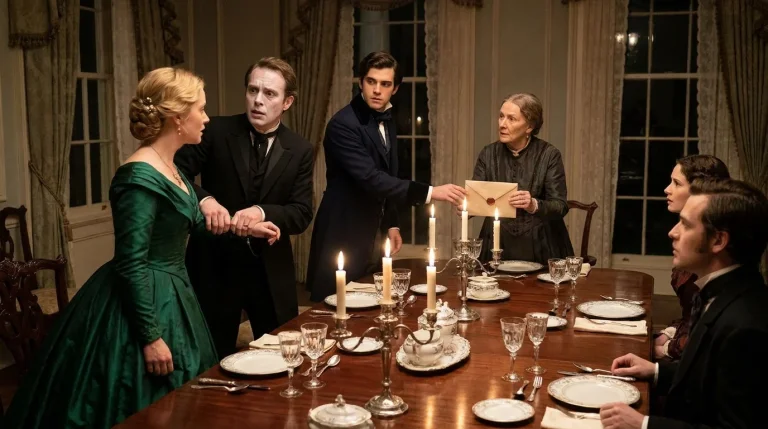
Clara testified after him. She described the letters, the account book, and the pressure to sign the transfer. She did not deny that she and Thomas had been close before her marriage. She explained that their friendship had been deliberately misrepresented to isolate her.
The judge ordered the trust protected and referred the financial evidence for trial. Henry was prohibited from managing the ironworks accounts. The medical report was declared unreliable, and no confinement order could proceed.
The ruling did not decide every question of guilt, but it gave Clara control of her legal affairs and prevented the immediate transfer of the shares.
Outside the court, Henry told Thomas that he had destroyed his brother’s future. Thomas replied that Henry had been destroying it for years by asking him to choose silence over conscience.
The Final Truth
The final piece of evidence came from the old family solicitor’s daughter. Her father had died, but she had preserved a locked dispatch box containing copies of letters he had been instructed to destroy. Among them was a letter from Clara’s father to Lady Margaret.
It stated that the trust shares could never be used to secure private debts. It also warned that the ironworks would be placed under independent management if any Whitmore attempted to control the fund. Clara’s father had suspected the family would try to absorb the trust after his death.
The letter proved that Lady Margaret had known the restriction before arranging the marriage. She had not simply misunderstood the deed. She had chosen a husband for Clara who could be pressured into taking control of the shares.
A second letter revealed that Henry had not been the original architect of the scheme. Lady Margaret had first approached Rook. Henry was told the trust could legally be absorbed into the estate. When he later discovered the truth, he continued because he feared exposure and prison.
Clara now understood why Henry’s cruelty had intensified when she questioned the accounts. He was not only protecting his pride. He was trying to prevent the discovery that his mother had used him as both instrument and shield.
The truth did not make Henry innocent. It explained the shape of the trap and showed that the family had been built around a lie long before Clara entered it.
Restitution
The court ordered the remaining trust assets returned and appointed independent trustees to oversee the ironworks shares. Rook’s company was investigated for the wartime contracts, and several officials were required to answer questions about missing supplies. Henry was convicted on the fraud charges connected to the trust and received a prison sentence. Lady Margaret was not imprisoned because of her age and health, but her role was formally recorded, and she lost control of the estate’s charitable accounts.
The workers’ relief fund reopened with a public register. Each widow could inspect her payment record and challenge an error. The first restored payment went to Ada Mercer. She used it to keep her youngest child in school.
Clara did not become wealthy from the proceedings. Much of her inheritance was tied to the trust, and the estate required years of repair. But she gained something Henry had tried to take: the authority to make decisions about her own life.
Thomas helped establish a board that included workers’ representatives. He refused to become the sole manager. He believed the trust should never again depend on one family’s goodwill.
When Clara visited the mill, the workers did not cheer. They watched to see whether the promises would hold. She understood. Trust would be measured in wages paid on time, safe machinery, and honest accounts, not in speeches.