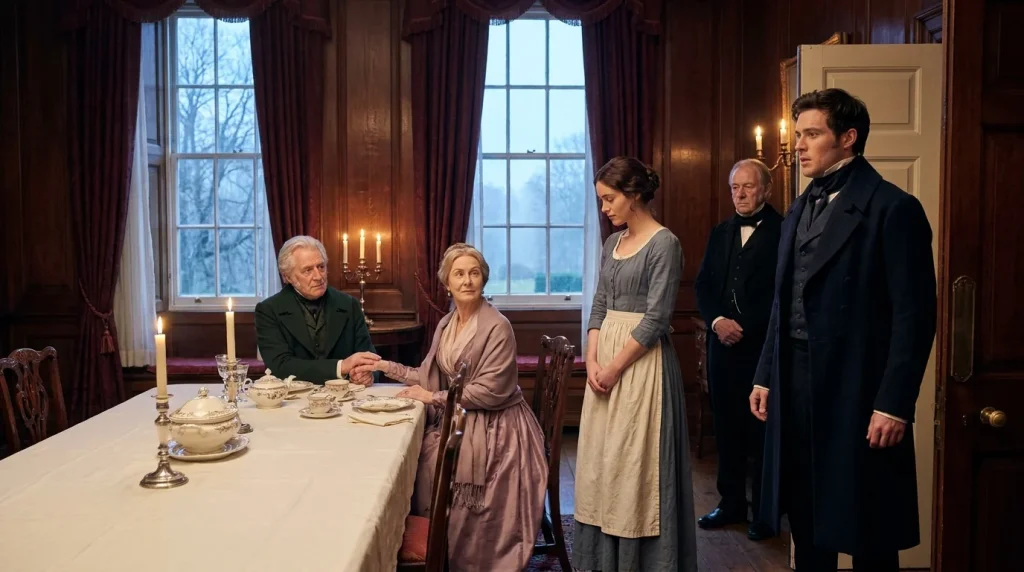
“No one lasts more than a week with them,” the butler warned Marianne Cross before letting her in.
She only nodded, her stomach empty and her shoes worn through. Old Lord Reginald would scream in confusion at night, and his wife wept inconsolably since losing her memory. The duke, fed up with hiring and firing maids, didn’t even bother to meet the new one. A month later, he returned unannounced and found something he didn’t expect: his parents dining in peace, holding hands while a young stranger served them with infinite patience. He stood motionless in the doorway.
What if this stranger knew something about love that he had completely forgotten? Marianne Cross hadn’t eaten anything but a crust of bread for three days when she reached the service entrance of Ashcombe Hall. She was twenty-two, her hands cracked by the November cold, carrying a cloth bundle containing everything she owned in the world. She had no reference letter because her last mistress had died without leaving a written record of her work, and without that letter, no respectable house would hire her. She knew it well; that was how things worked.
A maid without references was a maid without a name, suspected of theft or something worse, condemned to the streets or, if her luck ran out entirely, to the poorhouse where her own mother had died ten years earlier, forgotten among strangers, with no one to remember her face or her voice. If Ashcombe Hall rejected her too, she would have no choice but to return to that same gray door of the asylum. That was what was at stake, and she knew it with the cold clarity of someone who has truly gone hungry. Mr. Whitlock, the butler, looked her up and down with the expression of a man who had already seen too many desperate women pass through that same door.
“No one lasts more than a week with them,” he repeated, as if to spare her the disappointment.
But that morning, no other maid had shown up, the elderly housekeeper had just left due to illness, and the duke’s parents had gone two days with nothing but cold trays left in a hurry outside their door. Whitlock sighed, looked at Marianne’s ragged bundle, and, against all common sense, let her in. The first thing Marianne encountered upon climbing the service stairs toward the masters’ bedrooms was weeping. Not a cry of physical pain, but something deeper: the sound of someone lost within their own life. Lady Honoria sat by her bedroom window with her silver hair loose over her shoulders, holding a miniature portrait she kept looking at as if for the first time.











