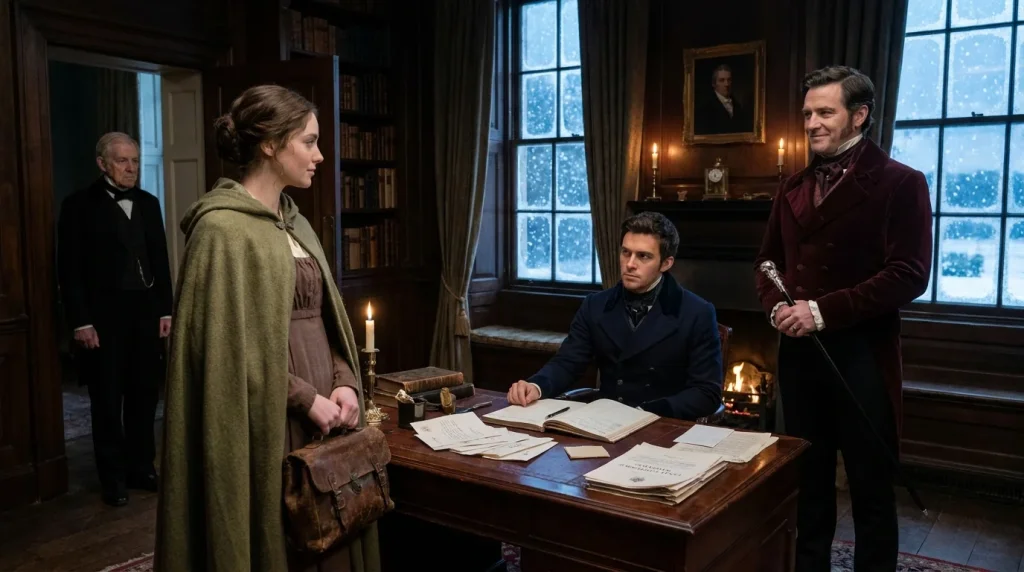
In snow-buried Yorkshire, Alistair Fenwick, Duke of Ravenshollow, received the letter that could end 200 years of his family’s history. He had 30 days to settle a debt of £12,000 or the estate would be seized. Six bankers had already refused him. Then a poor widow walked into his study and laid a plan on his desk that asked for no loan at all. Lord Blackthorn laughed and called her a fool.
The duke reached for the bell to have her removed until he read the final figure. He stood stunned. How did she know?
Snow fell on the black slate roofs of Ravenshollow Hall through the whole of that December in 1819. And by the middle of the month, the great house seemed less a castle than a stone ship stranded in a white sea.
In the study, Alistair Fenwick sat before a fire that had burned down to a few red coals, surrounded by letters from banks and ledgers stacked like crumbling walls. He was 35 years old, tall and dark-haired with gray eyes that gave away nothing, and he wore black gloves even indoors because the cold had settled into the very walls. Six banks had refused to extend his credit or to postpone his obligations. The seventh letter delivered that morning by a mud-spattered courier was the cruelest, for it named £12,000 and gave him exactly 30 days. Alistair understood that the estate was far more than a castle and a title.
More than 100 families of tenants lived on his land, farming its fields, tending its flocks, and depending on the mills and storehouses for their wages. If he failed, the loss would not stop at the name of Fenwick. It would spill down every lane and into every cottage. His father had taught him that a duke must never fail and had left him along with that lesson a tangle of poorly kept accounts and ancient habits nobody dared question. The war with France had ended, but the peace had brought falling prices and empty markets, and men who once begged for favor now crossed the street to avoid him.
Pride was the only fortune he still owned in full. Lord Percival Blackthorn arrived that afternoon, shaking snow from a fur-lined coat and leaning on a cane topped with silver. He was 46, immaculate, graying at the temples, and he smiled with the patience of a man who has already read the ending of the book. He offered to rescue the Duke with a temporary sum, and in return he wanted the lease of the storehouses, the loading wharves, and the southern acreage for 30 years. He spoke as though he were bestowing a gift, and he added gently that the honor of the Fenwick name should not be sacrificed for the sake of a few tenant farmers.
Alistair read the terms twice and recognized that they would strip his family of control over its own income for a generation. He refused. Percival’s smile did not falter.
“You have 30 days, Your Grace,” he said, drawing on his gloves. “Pride is not a currency any bank will accept.”
The door closed behind him, and the silence that followed seemed heavier than the snow. Alistair stared into the dying fire and counted what remained to him, a handful of weeks, a few loyal servants, and no plan. He had been trained to command, never to beg, and he did not know which of the two he would be forced to do. Edmund Sowerby, the gray-haired butler who had served the house for most of his life, appeared at the door with a hesitant cough. A widow from the town of Hawthorn Beck was asking to see the Duke, he said, and she had already called twice only to be turned away by the secretary.











