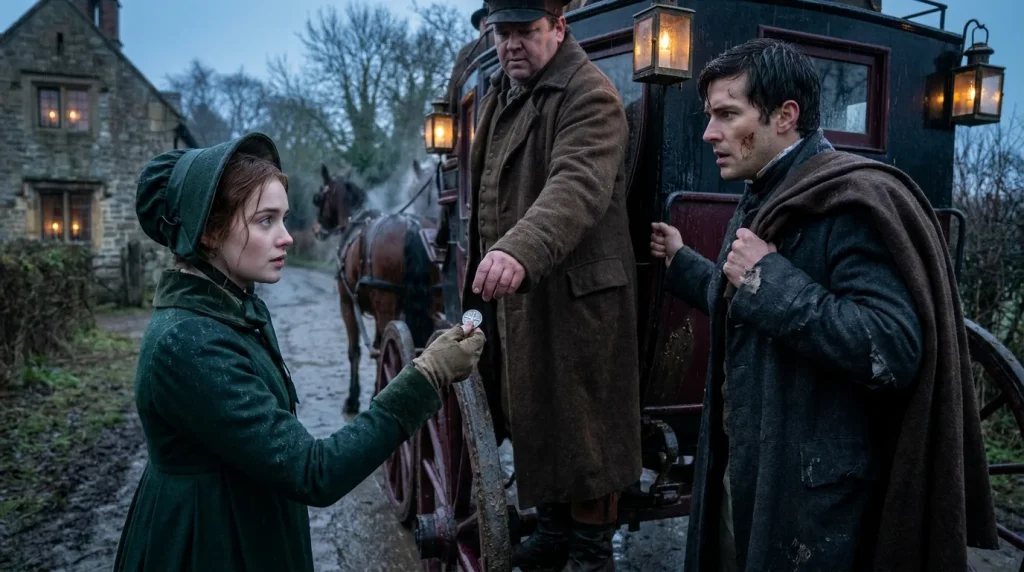
She paid a stranger’s coach fare with her very last shilling. It happened at dusk, in the rain, at a lonely crossroads called Hartley Gate. The Bath coach had stopped beside the old tollhouse. The lamps hissed and spat. Water ran from the brim of every hat on the roof.
“Five more miles to Kelbridge,” the coachman shouted, “and you’ve not paid a penny since Marlborough. Pay up or get down.”
The man he was shouting at sat at the very back of the roof. His coat was torn at the shoulder. Mud had dried along one side of his jaw. He did not argue. He simply reached for the iron rail to climb down, and his left leg nearly folded beneath him.
Hannah Bell watched him. Inside her glove, pressed hard into her palm, was one silver shilling. A tiny cross had been scratched beside the king’s head. It was the last coin she owned in the world. It was meant to buy her bread and a bed when she reached Bath.
She held it out.
“Take this,” she said, “for his fare.”
The coachman bit the coin and pushed it into his waistcoat. The stranger turned and looked at her for a long moment. He had gray eyes, tired and very sharp.
“Why?” he asked.
“Because no one should be left at the roadside,” she said.
He did not tell her his name, not that night. But the man she had just saved from five miles of rain and darkness was Gabriel Thorne, the eighth Duke of Ashcombe. He owned the road they were traveling on. He owned the inn they had left that morning. And before the leaves had fallen that year, he would stand up in a crowded room in front of half the county and speak her name as if it were the only word that mattered.
To understand why a young woman would give her last coin to a stranger, we must go back two weeks to a small booking office in the market town of Marlborough, and to a gold sovereign that went missing from a locked drawer. The Blue Lantern stood at the top of Marlborough’s High Street. It was a coaching inn with a wide stone arch, a cobbled yard, and a narrow booking office just inside the gate. Hannah had grown up in that office. Her father, Samuel Bell, had been a coach guard for twenty years.
He had ridden at the back of the Bath Road coaches through snow and summer dust with a brass horn at his side and a waybill buttoned inside his coat. When his knees grew stiff, he came down from the coach and took the booking desk instead. Hannah had sat beside him from the age of nine. Hannah learned to read a waybill before she could sew a straight seam. A waybill was a simple thing.
It was a long sheet of paper that traveled with every coach. On it was written the name of each passenger, where they were taken up, and what fare they had paid. The guard signed it at every stage.
“Every name on that bill is a promise,” her father used to say, tapping the paper with one thick finger. “We take their money and we carry them home. No one should be left at the roadside, Hannah. Not ever.”
By the time she was sixteen, Hannah knew every coach on the Bath Road by the sound of its wheels. She knew the Regulator from the Flyer by the rhythm of the hooves coming up the hill. She could tell you without looking at a clock that the London mail was four minutes late. She could glance at a coach roof and count its passengers faster than the ostlers could. It was not a skill anyone admired in a young lady, but it was hers, and she loved it.











