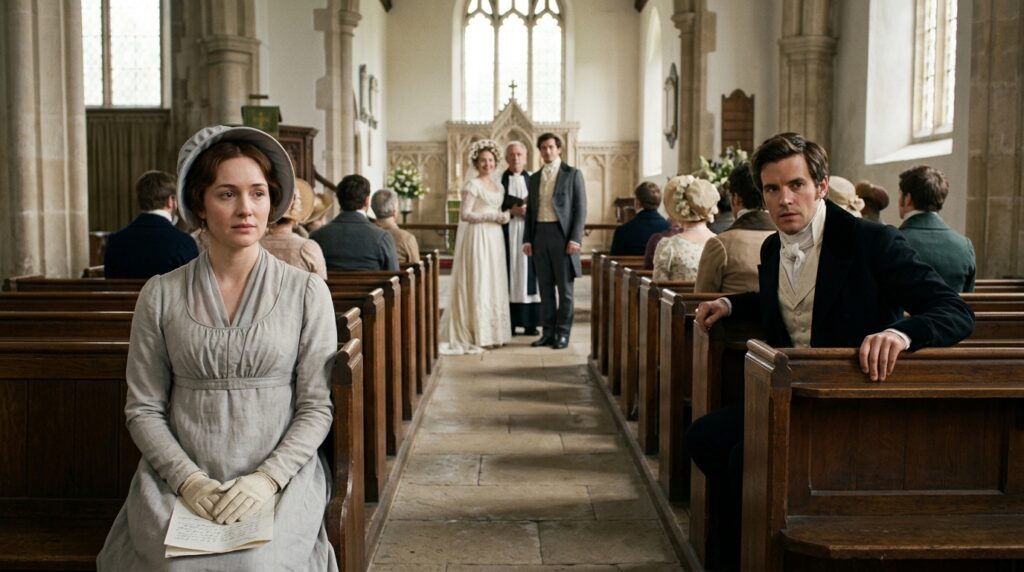
She had come only to watch her sister marry, to sit quiet in a back pew, and be glad for someone else’s happiness. Eleanor smoothed her plain gray dress and told herself she would not cry, not from joy, and not from the old ache of being the sister no one chose. The organ began. Her sister Clara came down the aisle glowing, and the groom waited at the altar with his smooth pale smile. Then, before the parson could speak the first word, a man rose from the front pew, the Duke of Marban, tall, grim, entirely unexpected.
“Stop,” he said, “this wedding cannot proceed, and the woman who can tell you why is sitting in the back of this church, though the groom has spent a great deal of money hoping she would not come.”
Every head turned. Eleanor felt the whole church swing toward her like a door. She did not understand. She had come only to witness the vows. She did not yet know that she was the only person alive who could stop them.
Chapter 1
Eleanor Hartley was the plain sister, and she had made her peace with the word, mostly. Clara was the beauty. Eleanor was the one who taught music to other people’s children and copied out sheet music by hand for a shilling a page, because she had a gift that no one thought worth marrying. Eleanor could hear anything once and write it down true. Perfect pitch, her father had called it before he lost the family’s money and then his life to a fever.
She could sit at the back of a concert hall and copy a symphony note for note, or hear a folk tune whistled by a passing tinker and set it to paper. She earned the family’s bread by it now, copying scores for a music seller in town, and teaching the pianoforte to girls who would marry better than she ever would. When she was small, before the money went, her father used to test her at the supper table. He would hum three notes and cover his mouth and ask what they were and she would name them and he would laugh and call her his little tuning fork. Her mother had thought it an unwomanly accomplishment, better hidden than shown, but her father had understood it for what it was, a thing rare and whole, and Eleanor had loved him for it.
She did not resent Clara. That was important. Clara was sweet and a little vain and not at all clever, and Eleanor loved her the way you love someone you have protected since childhood. When they were girls, it had been Eleanor who plaited Clara’s hair each morning, Eleanor who sat up with her through fevers, Eleanor who told her the truth gently when the truth had to be told.
Clara had a way of walking into a room and making everyone in it feel warmer. Eleanor had a way of standing at the edge of a room and hearing everything that was said in it. Those were their two natures, settled long ago and neither had ever thought to trade.











