The most painful passage concerned Nathaniel. Lady Margaret had written that she feared Charles would one day ask his younger brother to defend him against a woman who had done nothing wrong. She urged Nathaniel to remember that family loyalty should never require him to surrender his conscience.
Nathaniel read the letter aloud to Eleanor. He had spent years believing his mother had trusted Charles more because he was the heir. Now he understood that she had worried about both sons: one was being corrupted by power, the other trained to excuse it.
The letter also named a final trustee, Reverend Thomas Bell, who had been removed from the fund’s board after questioning the accounts. He was still alive and living in a small parish near York.
Eleanor asked Nathaniel to find him. If he had the original minutes from the trust’s early meetings, the evidence could establish that the fund had been deliberately protected from family use.
The next journey would take them away from Ashford Hall, but the truth was no longer confined to its walls.
The Beneficiary Returns
Anne Whitcomb arrived at Ashford Hall in early spring. She was no longer the girl in the portrait. She was twenty-six, dressed plainly, and carried a small portfolio of letters showing the education payments she had once received. She had come because Eleanor’s letter promised an explanation, not because she expected money.
Eleanor met her in the library. She apologized for the interruption to Anne’s schooling and explained that the fund’s accounts were being reviewed. Anne listened, then said she had survived by sewing and teaching children in the evenings. She did not want pity. She wanted the trust to be restored for the girls who came after her.
Her words changed Eleanor’s understanding of restitution. It could not simply mean returning a sum to an account. It had to mean rebuilding the opportunities that had been taken away.
Anne offered to help identify the other beneficiaries. She remembered names, schools, and families. Some had moved away. Others had married young or entered service. She had kept letters from two girls who had once shared her classroom.
Nathaniel helped her organize the information. Mrs. Finch prepared tea. For the first time, the library was used not for family arguments or business bargains, but for the people the trust had been created to serve.
When Anne left, she gave Eleanor a small book. It was the grammar she had received from Lady Margaret.
Inside the cover, the old woman had written: “A mind is a possession no creditor can seize.”
Eleanor placed it beside her father’s papers. The words felt like a promise that had survived the men who tried to erase it.
The Trial of Charles Ashford
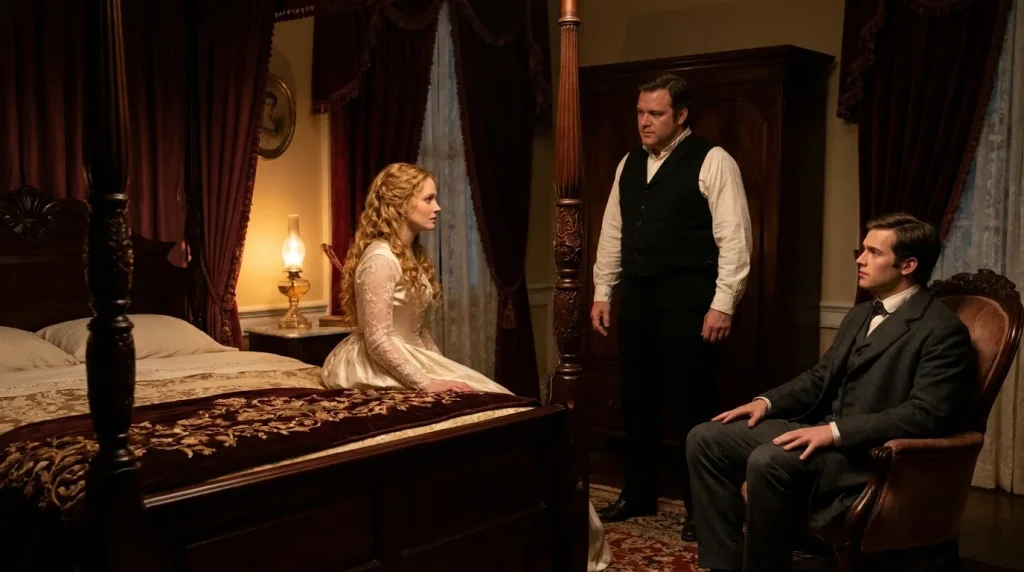
The financial case moved slowly. Sir Alistair Wren’s influence delayed several requests, and Charles’s solicitor challenged every document. But the combined testimony of the steward, physician, housekeeper, and trustees made it impossible to dismiss the matter as a quarrel between husband and wife.
Charles was eventually charged with fraud involving the charitable trust and with attempting to procure unlawful confinement through false medical statements. The court did not treat the bedroom assault as a mere domestic disagreement. Eleanor’s testimony, supported by the physician’s admission and the household evidence, established a pattern of intimidation.
At trial, Charles presented himself as a man who had sacrificed everything for his family. He spoke of debts, duty, and the burden of maintaining an estate. He never mentioned the girls who had lost their education or the women whose shelter payments had been diverted.