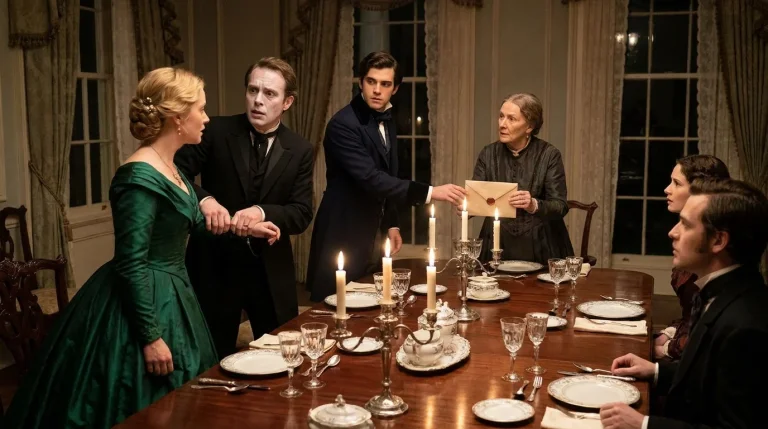
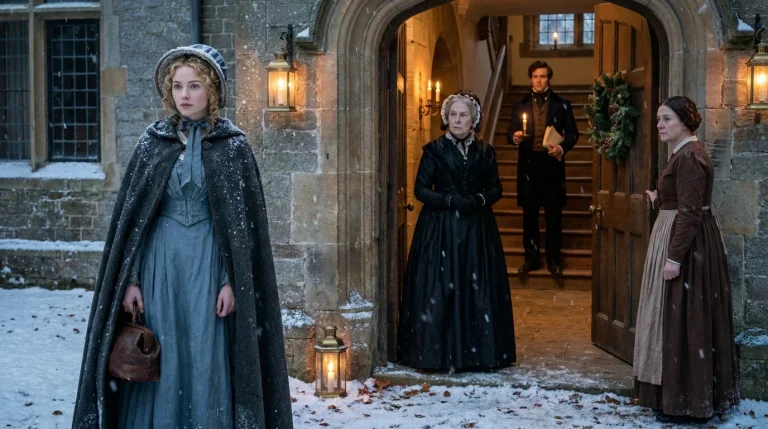
Charles looked toward the door. Two magistrates were already speaking quietly with the vicar.
For the first time, his title did not command the room. It merely gave everyone a reason to watch him more carefully.
The household had learned to survive by avoiding difficult questions, and that habit would not disappear simply because one person had finally spoken. Each honest answer made the next question harder, but it also made the old excuses less convincing.
The Woman Charles Feared
Charles’s greatest fear was not the inquiry. It was the woman he had tried to silence. Eleanor had been raised by a father who believed that education was the one inheritance no husband could seize. She could read accounts, understand contracts, and remember every figure she had ever been shown. Charles had mistaken her quietness for ignorance.
When he married her, he had expected a grateful wife who would sign where he pointed. Instead, she had learned the estate’s finances, questioned the steward, and asked why the charitable fund had stopped supporting two girls at the village school. Those questions had begun the conflict long before Nathaniel heard her cry.
Eleanor explained this to the guests. She had not discovered the fraud by accident. She had been investigating it for months, carefully comparing the trust’s original accounts with the household books. The night Charles attacked her, he had demanded the last missing page from the ledger.
Charles denied it. He said she had been confused by grief and had invented a story to injure him. Eleanor asked the physician to repeat what he had told Nathaniel. Hargreaves, standing near the door, confirmed that Charles had asked for a report before examining her.
The doctor did not look at Eleanor as he spoke. He looked at the floor.
Her testimony did not make her invulnerable. It made the room unable to pretend she had no voice. The trustees asked for the records to be secured. The magistrates requested that Charles remain at the estate until they could question him.
He laughed once, but no one joined him.
The papers were kept away from the fire and the damp, because a document could matter more than a gentleman’s promise.
A Brother’s Choice
After the guests departed, Charles found Nathaniel in the library. He demanded to know whether his younger brother intended to destroy the family. Nathaniel replied that the family had been endangered by the theft and coercion, not by the disclosure.
Charles reminded him of their childhood, their father’s funeral, and the years he had kept the estate from bankruptcy. Nathaniel acknowledged those sacrifices. He also said that sacrifice did not grant Charles ownership over every person who lived beneath the Ashford roof.
Charles confessed that he had expected Nathaniel to understand. He had always believed the younger brother would protect him, no matter what happened. Nathaniel said he had once promised to stand beside him, but he had never promised to lie for him.
The brothers stood across the desk where their father had once settled disputes. Charles’s hand shook as he poured a drink. He said Eleanor had turned them against each other. Nathaniel answered that she had only refused to disappear.
Then Charles made a final appeal. He said if Nathaniel testified, the estate might be seized and the servants would lose their livelihoods. Nathaniel knew the danger was real. The estate employed dozens of families, and a scandal could leave them without wages.
He told Charles that the trustees would have to protect the workers while investigating the accounts. The answer did not satisfy him.