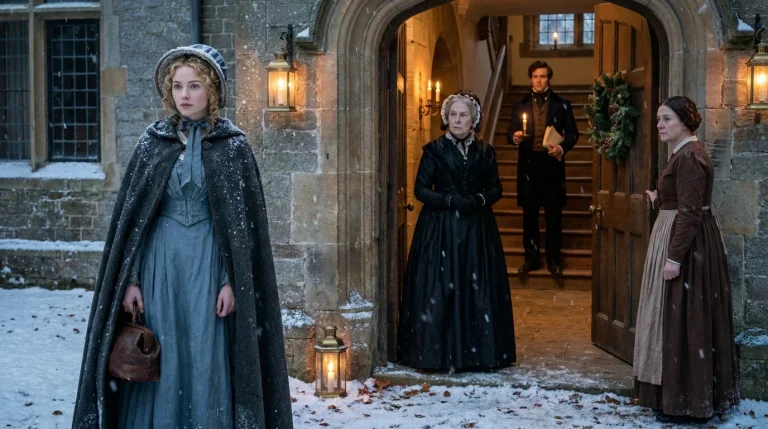
The Price of a Name
Sir Alistair Wren arrived at Ashford Hall with a solicitor and an offer. He proposed to repay the trust’s missing money quietly if Eleanor withdrew her complaint and Charles resigned from the estate’s management. The arrangement would avoid public embarrassment and protect the servants from uncertainty.
Eleanor listened without interrupting. Wren spoke as though he were offering mercy. He described the scandal as a private misunderstanding and warned that a public inquiry would damage the family name beyond repair.
She asked whether the girls whose education had been interrupted would receive their places back. Wren said the trust could be restored in time. She asked whether the women whose shelter payments had been diverted would receive compensation. He said those details could be handled later.
Eleanor understood that the offer was not restitution. It was another attempt to purchase silence.
She refused.
Wren turned to Nathaniel and suggested that a younger son with no estate of his own should not interfere in matters of finance. Nathaniel replied that he had seen the evidence and would testify.
Wren left without shaking hands.
That evening, Eleanor received a letter from one of the girls supported by her father’s fund. The girl, Anne Whitcomb, had been forced to leave school because her stipend had stopped. She had taken work as a seamstress and was now caring for two younger siblings. She wrote that she did not blame Eleanor, but she wanted to know whether the school would ever take her back.
Eleanor read the letter twice. The abstract sums in the ledger had become a family living in one cold room. She decided the inquiry would continue, whatever it cost the Ashfords.
The Confession at Dawn
Dr. Hargreaves came to Eleanor before dawn. He had spent the night writing a full statement. He admitted that Charles had asked him to describe Eleanor as unstable and had offered a substantial payment. He had agreed because he feared losing his position as physician to the county’s wealthiest family.
He also revealed that Charles had told him Nathaniel was dead. The false report had been used to explain why Eleanor could not seek help from her brother-in-law. Hargreaves had repeated the story without checking it.
Eleanor asked whether he had ever believed she was ill. He said he had seen grief and fear, but no condition that justified confinement. He admitted that he had allowed Charles’s influence to shape his judgment.
The confession was signed and witnessed by Mrs. Finch. Nathaniel sent it to the magistrate.
When Charles learned of it, he confronted the doctor in the stable yard. The argument drew servants from the house. Charles called Hargreaves a coward and threatened to ruin him. The doctor replied that Charles had already ruined enough people.
The exchange ended when the magistrate’s men arrived with a request that Charles accompany them for questioning.
Charles did not resist, but he looked toward Eleanor as he passed.
“You will regret this,” he said.
Eleanor answered quietly, “I have regretted being silent.”
For the first time, she did not lower her eyes.
The cost of silence had already been paid by people who had the least to spare. She would not confuse a public apology with restitution.
A House Without a Master
With Charles removed from the estate’s daily management, Ashford Hall entered an uneasy pause. The servants did not know whether they would be paid. The steward’s office was sealed, and the household accounts were placed under review. Nathaniel offered to manage essential operations until the trustees appointed an administrator.