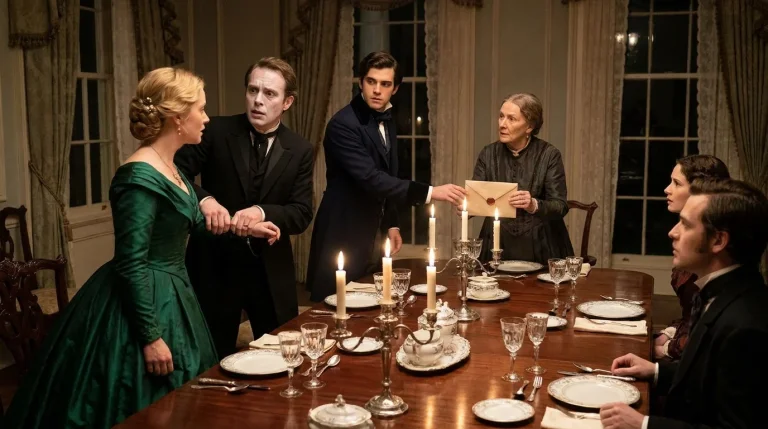
Eleanor knew the moment would not last. Charles owned the estate, controlled the household accounts, and had friends in the county magistracy. If Nathaniel acted without understanding the danger, the family would turn his protection into an accusation against her.
Outside, the weather changed without regard for the trouble inside Ashford Hall and the surrounding county. Carriages still passed, servants still carried trays, and neighbours continued their ordinary errands.
The Letter Beneath the Floorboard
After Charles left, Eleanor asked Nathaniel to meet her in the old schoolroom. She locked the door and removed a loose board beneath the window seat. From the narrow space she drew a packet tied with blue thread. The letters were not love notes. They were copies of instructions sent between Charles, his steward, and a London solicitor.
The documents described a plan to declare Eleanor mentally unfit and place her small inheritance under Charles’s permanent control. Her father had left her a railway share portfolio and a modest trust, both of which Charles had promised to protect. Instead, he had borrowed against the shares to cover gambling losses and a failed land venture. When the loans came due, he needed Eleanor declared incapable of managing her affairs.
Nathaniel read the letters twice. One was written in Charles’s hand. Another bore the signature of Dr. Hargreaves, the family physician, who had agreed to describe Eleanor’s grief as a continuing illness. A third referred to a private institution outside Bath, where she might be confined until she signed the necessary papers.
Eleanor explained that she had discovered the plan when a clerk mistakenly delivered a duplicate account to her room. She had copied what she could and hidden the copies. The confrontation in the bedroom had begun when Charles found a missing page and demanded to know where she had put it.
Nathaniel felt the old loyalty to his brother struggle against the evidence. He asked why she had not gone to the authorities. Eleanor gave a tired smile.
“Your brother dines with the magistrate every Thursday.”
She had not been waiting for a rescuer. She had been waiting for proof strong enough to survive the influence of the man who wished to destroy her.
Eleanor understood that the truth would need more than courage. It required dates, witnesses, copies, and a record that could survive the influence of a respected family. She kept each paper in order and resisted the temptation to answer every insult.
The Younger Brother’s Promise
Nathaniel had once promised his mother that he would always stand beside Charles. The promise had been made when they were boys, after their father died and the estate passed to a son too young to understand its debts. Charles had carried the title; Nathaniel had carried the expectation that he would never embarrass it.
He now understood how that promise had become a chain. Charles invoked family loyalty whenever he wanted silence. He called Eleanor unstable, the servants disloyal, and Nathaniel ungrateful. The family name had become a shield behind which every wrong could hide.
Nathaniel asked Eleanor whether she wanted him to take the packet to the magistrate. She shook her head. Not yet. The copies proved fraud, but the originals were still in Charles’s study. Without them, the solicitor could claim the letters were altered. She also feared that the steward, Mr. Vale, would destroy the account books.
They agreed on a careful plan. Nathaniel would speak to the estate solicitor, Mr. Pembroke, without revealing everything. Eleanor would ask the housekeeper to retrieve the physician’s appointment book. The servants who had seen Charles’s conduct would be given a chance to speak privately, without pressure.