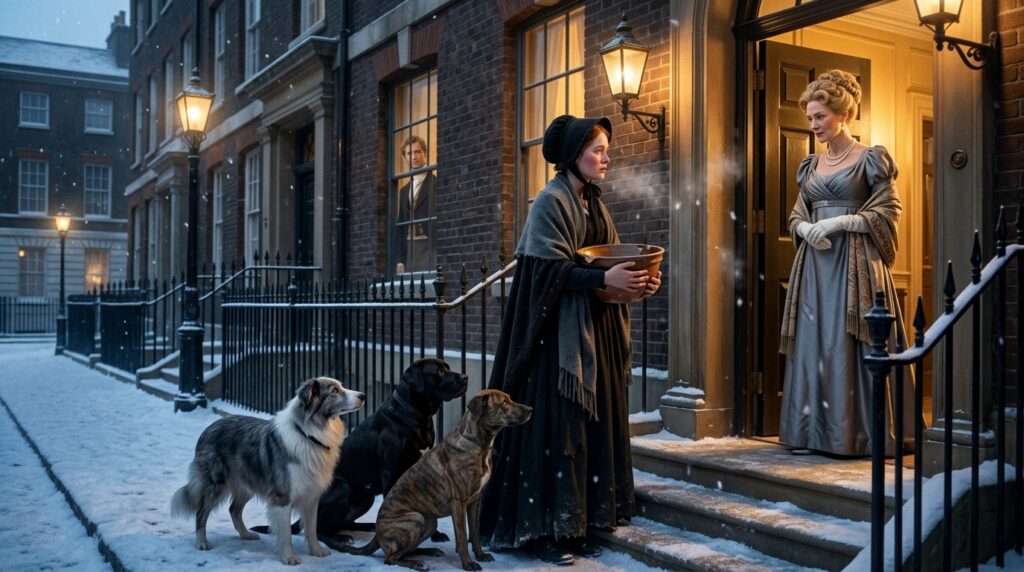
Elizabeth had come up into the hall at the sound of his voice. She stood behind the Duke as he opened his front door, and she felt her heart go hard and small inside her. The pound meant the man in the inn yard. Everybody knew where the pound dogs went at Christmas. Juno came to her side. Rook came and stood in front of her, square and black, and did not make a sound.
The Duke went out onto his top step and stood there. He did not raise his voice. He did not need to. The whole square had heard of him and had been told for years what he was. Now it saw him standing bareheaded in the cold with three moor dogs at his back and a young widow in mourning in his doorway.
“The dogs are in my house,” he said. “Do you mean to come into it?”
The beadle looked at the Duke. He looked at the door, which nobody in the square had walked through in living memory. He looked very briefly over his shoulder at the Duchess on her step. Then he touched his hat and said that he would not dream of it, and that he had been misinformed, and that he wished His Grace the compliments of the season. He walked away across the snow rather faster than he had come.
“Harry, my dear,” the Duchess called across the low wall between their houses, light and fond, as though they were alone in a drawing room. “You must not let the poor creature impose on you. She will have you keeping a dairy next.”
“Good morning, Sophronia,” the Duke said, and went in and shut his door on her as softly as she had shut hers.
He sent for Elizabeth that afternoon. His study was at the top of the house, a long room lined with books and maps of the moor, with a fire that had been allowed to go low and the shutters open on the white square. He did not ask her to sit. He stood with his back to the fire and his hands behind him, and for a while he said nothing at all. Juno had followed her up the stairs. The old dog went and lay down on the hearth rug at his feet, and he looked at her there, and seemed to find something in that which he needed.
“You know what is said of me,” he said at last.
“I know what is said.”
“Do you believe it?”
Elizabeth thought of every farm kitchen where she had heard it. She thought of the women who had turned their faces away at the lychgate, the one time his carriage went by last Christmas, and of the boys in this very square, who would not run a stick along his railings. Then she thought of Matthew at their supper table putting down his knife.
“My husband did not,” she said. “He said it once to me in 5 years. He said, ‘You were not what people said.’ He would not tell me any more than that. He said it was not his to tell.”











