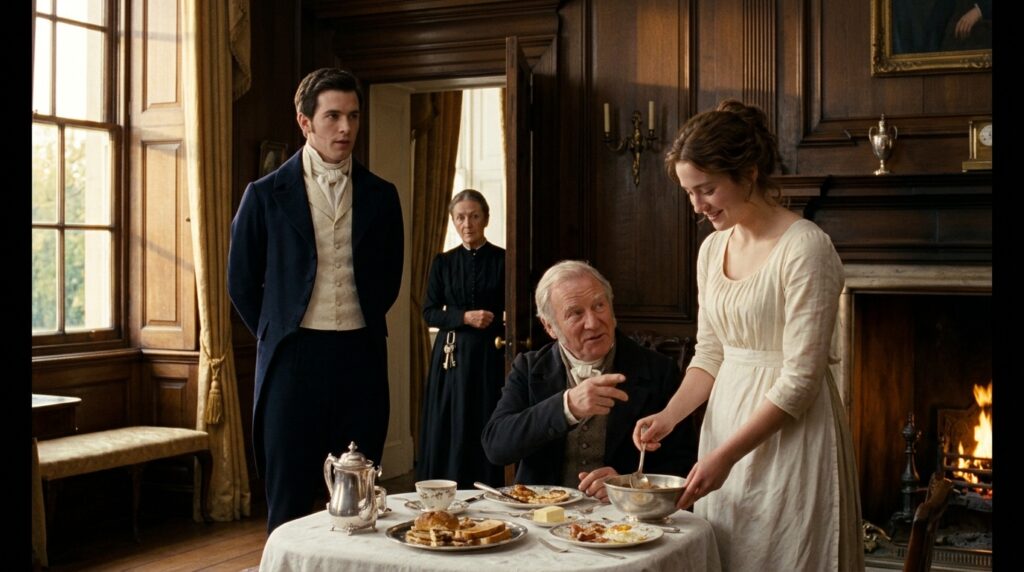
He sat down at the table. And when she put a bowl of mutton broth in front of him with barley in it and a little parsley on top without a word from either of them, he picked up the spoon and ate every drop. It was a week to the day after the fair when William came down the hill. Sarah did not hear him.
The cottage was full of noise that evening: the fire spitting, the pot lid rattling, the old man telling her a long story about a ram that had once chased the rector into the duck pond. He had begun to talk in the last few days. It came out of him a little at a time like water from a spring that has been stopped up a long while.
He was sitting at the table with a plate of boiled bacon and cabbage in front of him and a mug of small beer by his hand. There was color in his face for the first time. In the middle of the story, he laughed, a great, rusty bark of a laugh that seemed to surprise him, and banged the table so the plates jumped. And then the door opened and the cold came in.
And there was William. He stood on the step in his dark coat with the evening behind him going blue over the down. And he looked at his father as though he did not quite believe what he was seeing. Behind him, a little to one side, stood a woman Sarah did not know.
She was perhaps 60, thin and very neat in black silk with a white cap and a heavy ring of keys at her waist. She held a covered basket on her arm. Her face was pleasant and composed. Her eyes went once round the cottage to the fire, and the clean dresser, and the bacon on the table, and then came to rest on Sarah.
“Mrs. Dibbin,” William said, without looking round. “My housekeeper. She wished to see how you did.”
“How very kind,” said Sarah.
“Not at all.”
Mrs. Dibbin smiled. It was a good smile, warm and practiced.
“His Grace’s father has been a great anxiety to us all, Miss Quillgrove. I have sent down a basket every day since the spring. Calf’s foot jelly, beef tea, all of it sent back.”
She set the basket on the dresser.
“And here you are, a week in the house, and quite at home already. You have a gift for making yourself at home, I think.”
The words were perfectly polite. Sarah heard what was under them, all the same. The way a cook hears a pan begin to catch before it smells. She said only:
“Mr. Gauntlett has been very patient with me.”
“I have not,” said Nathaniel cheerfully, and took another mouthful of bacon. He looked at his son over the rim of his mug. He looked at Sarah standing by the hearth with the ladle in her hand. He looked back at his son, who had not taken his eyes off her since he came in. Something moved in the old man’s face, quick and shrewd and full of mischief. And he put down his mug and said, loud and clear, as if it were the most natural thing in the world:
“She’s wasted on an old man like me. You should marry my son.”
Nobody moved. The fire spat. The pot lid rattled once and was still. Sarah felt the heat go up her throat and into her face, and she held the ladle perfectly steady, because if she let it shake, they would all see. William had gone white about the mouth. He said, “Father,” in a voice she had never heard him use, very low. Behind him, Mrs. Dibbin’s keys gave a single small clink, as though her hand had closed on them. And when Sarah looked at her, the housekeeper was not smiling anymore. She was not amused or shocked or even offended. She was afraid. It was there for one moment, naked in her face, and then the pleasant mask came down over it again.











