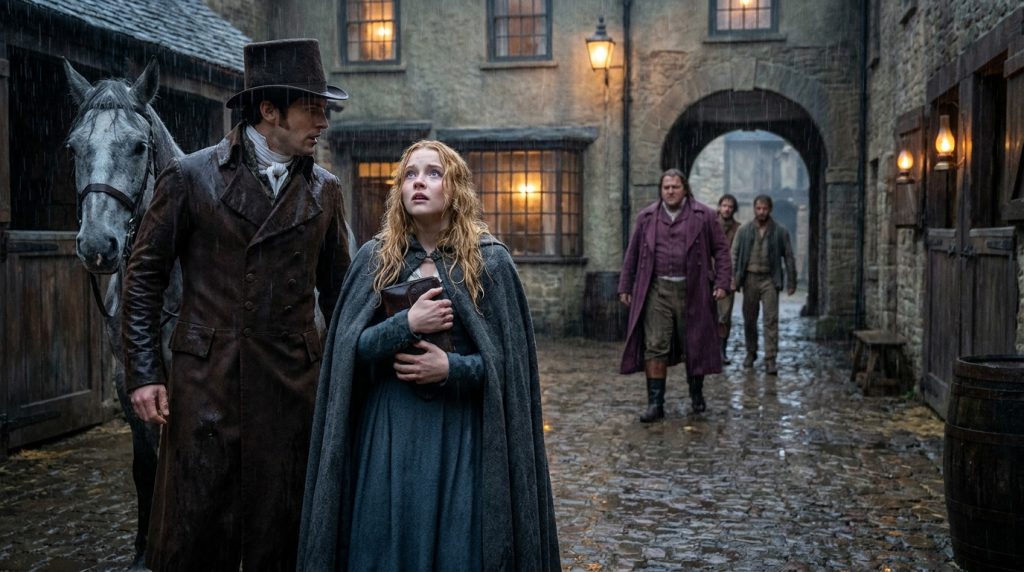
“Tell him I’m your wife,” she begged the Duke.
Then he saw the man chasing her. He did not ask her name. He did not ask what she had done. He simply took off his hat, settled it over her rain-soaked hair, and called out:
“There you are, my love. You’ve kept me waiting in the rain again.”
By Christmas, she would be wearing his ring. And what would still trouble her was that he stubbornly refused to let her repair his watch. But on that wet November evening in 1818, in the courtyard of the Bull Inn at Stony Stratford, she had no idea he was a duke. She thought he was a man tending a horse.
And, to be fair, that was precisely what he looked like. Robert Lyle, the eighth Duke of Caro, was crouching in the mud beside his gray horse. The animal had lost a shoe two miles back on the London Road. The Duke wore a plain brown riding coat that reached his knees.
He had no servant with him, no family crest displayed on anything, and very little patience left. He had chosen to travel home alone from London because he hated being fussed over. Now he was paying for that decision, one cold raindrop at a time.
Then a young woman came racing across the cobblestones. She clutched a small leather case to her chest and seized his sleeve as though he were the last post on a sinking pier. Behind her, a large man in a mulberry-colored coat came panting through the archway. He carried a gold-topped cane. Two burly hired men followed him like a pair of threats.
“Stop that woman!” the large man roared. “Thief! Stop her!”
The Duke straightened to his full height. He stood a head taller than everyone in the yard, almost including the horse.
“I would rather you did not shout at my wife,” he said gently. “She dislikes it. So do I.”
The large man stopped dead.
“Your wife?”
“My wife,” the Duke said.
“Since this morning,” the young woman said, at the exact moment that he said, “Since Tuesday.”
There was a brief and dreadful silence.
“Tuesday morning,” they both said together.
The large man narrowed his little eyes.
“And who might you be, sir?”
“Lyle. Robert Lyle.”
That was entirely true. He simply omitted the rest: the dukedom, the fourteen thousand acres, and the great house in Northamptonshire with its 112 windows, every one of which, his aunt complained, let in a draft.
“Well, Mr. Lyle,” the large man said, smiling like a crack in a cheap plate, “my name is Barnaby Coyle. I keep a very respectable pawnbroker’s shop on Cow Cross Street in Clerkenwell. And that young woman is Prudence Tolliver. Her father promised her to me in writing before he died. She has also stolen a gold watch belonging to me. It is worth three hundred pounds.”
“It belongs to a customer,” the young woman snapped. “And my father never promised me to anybody. He could scarcely hold a pen.”
“Then where were you married?” Coyle demanded. “Tell me that.”
“Clerkenwell,” Prudence said.
“St. James’s Church,” the Duke said.
Another silence followed.
“We were married twice,” Prudence declared firmly. “He is very thorough.”
The Duke coughed into his glove. It might have been a cough. It might have been something else. Coyle’s face grew nearly as purple as his coat.
“Prove it, then. A real wife knows her husband. What does he carry? What does he like? What does he do?”
Prudence did not let him finish. She turned and slipped two fingers into the Duke’s waistcoat pocket as though she had done so a thousand times before. Then she drew out his watch. The Duke went perfectly still. Women did not generally go rummaging in men’s pockets. Ladies normally curtsied to him and inquired about the weather.











