“She had work enough to support herself.”
“She was supposed to have an allowance.”
The Dowager turned toward her granddaughter.
“Do not confuse yourself with matters settled before you were grown.”
“But not before I was old enough to repeat what you said.”
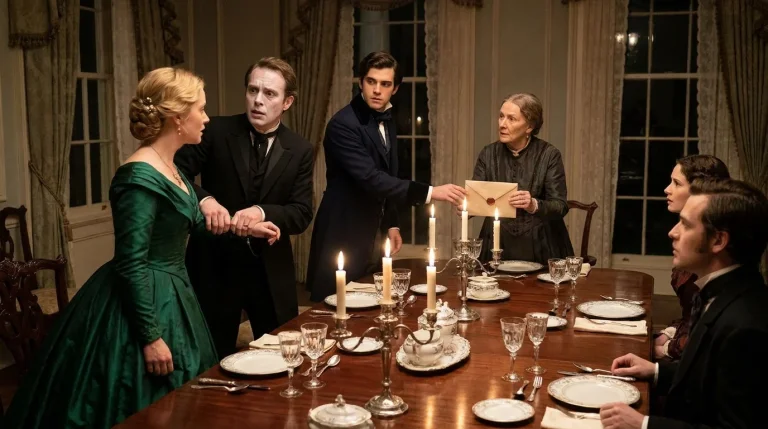
Fenton opened the bank record. There were transfers for house repairs, payments against Margaret’s father’s borrowing, and sums associated with her first London season. He did not raise his voice as he read them. He did not need to.
Margaret put a hand on the table.
“You said the carriage came from my father’s money.”
“Your father owed this family far more than the cost of a carriage.”
“And she was a servant,” Sophie said. “So it did not matter if she paid instead?”
The Dowager’s patience broke.
“Anne understood her place. It is unfortunate she did not teach you yours.”
Margaret rose so abruptly that her chair struck the wall.
“She did teach her.”
Everyone looked at her.
“She taught her to nurse a person who was frightened and unpleasant and did not deserve it. I have had every advantage you could give me, Grandmother, and she was still kinder to me than I was to her.”
Her voice shook. She sat down again, not triumphantly, but as though standing had become difficult.
“I knew the locket had been found. I let people go on believing the story when I was old enough to know better. Put that in the account too.”
Fenton made a note. Sophie looked at Margaret for a long moment.
“I will not ask you to make it sound better when you give your statement.”
“I know.”
“And I cannot forgive you because you have said it in this room.”
“I know that too.”
The first payment Margaret offered came from selling jewelry bought for her London season. It was not enough to repair the loss, and she did not claim otherwise.
There was another name in the papers: Jane Moss, whose mother had died while working in the Rosemere laundry. Eleanor had added the child to the trust with a small scholarship. The allowance had stopped, and Jane had left school to earn what she could. Fenton found her in Bath, supporting an elderly grandmother with washing and mending.
Sophie visited with Mrs. Harcourt. Jane’s room contained a washboard, two chairs, and a schoolbook with a paper cover carefully sewn over the original boards.
“Did they tell you I was dead?” Jane asked.
“They told the clerk the claims had been settled.”
Jane gave a short laugh.
“My grandmother wrote three times. We wondered what it meant when no one answered.”
The old woman brought a bundle of receipts from a biscuit tin. Some had been signed by a schoolmistress. Others recorded small payments received before the money stopped. She laid them on the table with the solemn care of someone who had never known whether keeping them would matter.
Sophie wanted to apologize, but the apology felt too small for the room.
“May I take copies?” she asked instead.
“Will that make them pay?”
“It will help us ask in a place where they must answer.”
Jane looked at the schoolbook.
“I should like to finish learning accounts. I can work a whole week and still not know whether I have been paid correctly.”
On the way back, Sophie said nothing for a long time. Mrs. Harcourt did not interrupt. At last Sophie turned toward her.
“George asked whether I would help administer what remained of the trust.”
“He did.”
“I thought it meant keeping a ledger. I think it must mean more.”