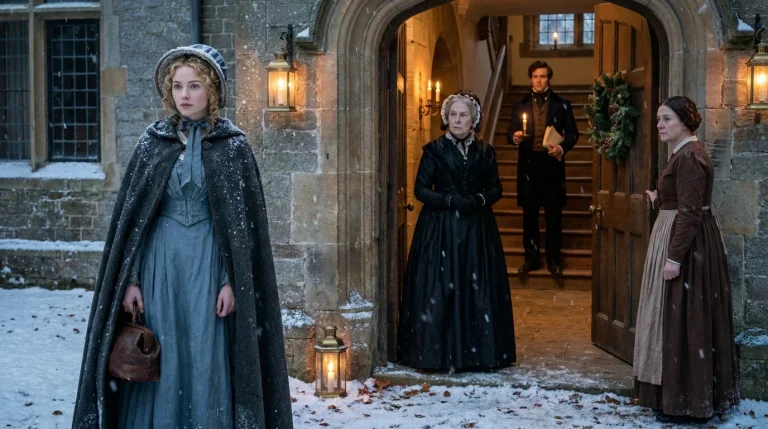
“Have they been informed about Jane Moss’s school fees?”
“Not in those terms.”
She took the untouched plate away and returned with something warm. When he began to thank her, she held up a finger.
“This is a supper. It is not an undertaking to supervise you for life.”
He smiled, tiredly.
“I am learning to distinguish them.”
They ate at opposite ends of the small table. He asked what she wanted to do with the income secured to her. She told him she wanted, first, a room no one could take back during an argument.
“And after that?”
“To find out what I want when I am not frightened of the answer.”
He set down his fork.
“I hope you will tell me when you know.”
“I might tell you something you do not like.”
“I think I ought to survive the experience.”
Sophie laughed. He watched her without immediately turning the moment into a promise, and she began to understand how much she wanted him beside her when the fear was gone.
The school began with a list, not a building. Sophie wrote down what Jane had wanted to learn, what her mother had taught her, and what the women who had brought the petition had needed when payments stopped. Reading, arithmetic, music, bookkeeping. The ability to examine a contract before trusting the person who offered it.
George read the list in the little parlor.
“This is the proposal I meant to bring you.”
“No,” Sophie said. “You meant to ask whether I would administer a fund. I should like to ask whether the fund can do this.”
“Then let us ask its trustees.”
She accepted the directorship only after the post was set down in writing, with a salary, defined responsibilities, and dismissal procedures that did not depend upon the household’s pleasure. Her personal inheritance remained separate. Former beneficiaries and women from working families were given a place in the school’s oversight, and the accounts would be published for inspection.
“No pupil loses her place because she displeases a donor,” Sophie said at the first meeting.
“Even if the donor pays for the place?” a gentleman asked.
“He pays into the fund. He does not purchase the girl.”
The rule was written down.
The school opened in the spring in a former steward’s house near Rosemere. Mrs. Harcourt helped arrange the residence. Jane returned first as a pupil and later assisted with the younger girls, keeping her own learning alongside her work. Sophie refused to open until every room had a sound window, a bed, books, and enough coal for the evenings.
Frederick arrived with a carriage full of books and stopped on the threshold.
“Where do you want these?”
Sophie considered him for a moment, remembering how many things had once arrived at Rosemere without anyone asking the people who would use them.
“Come and look at the shelves with me.”
They carried the books together.
On the first morning, six girls stood in the entrance hall with their names written on slips of paper. One had brought a broken slate. Another carried a bundle so small that Sophie wondered whether it contained anything beyond her spare stockings. Jane showed them the rooms while Mrs. Harcourt inspected the supper preparations with the severity she had once reserved for French pronunciation.
Margaret arrived carrying a box of writing paper.
“I thought it might be useful.”
“It will be,” Sophie said.
Margaret did not leave. At last she looked toward the girls arranging their few possessions on the shelves.
“Is there anything I can do?”
“You could write the labels for the drawers.”