They met most afternoons beneath a pear tree on the boundary between their estates. He was a younger son with a modest allowance. She had been raised to understand that affection seldom survived the calculations of powerful families. Still, they planned to marry after he returned from a summer appointment managing the duke’s southern properties.
Two weeks after his departure, Elias received a letter carrying Catherine’s handwriting. It said she had accepted Frederick’s proposal and wished him never to seek her again. Angry and wounded, he prolonged his assignment rather than return to face her.
Catherine, meanwhile, received a note apparently written by Elias. It claimed that their attachment had been pleasant but unsuitable, and that he would not sacrifice his prospects for a girl with no estate. His mother then informed her that Frederick could rescue her father’s creditors from legal action, provided she agreed to marry him.
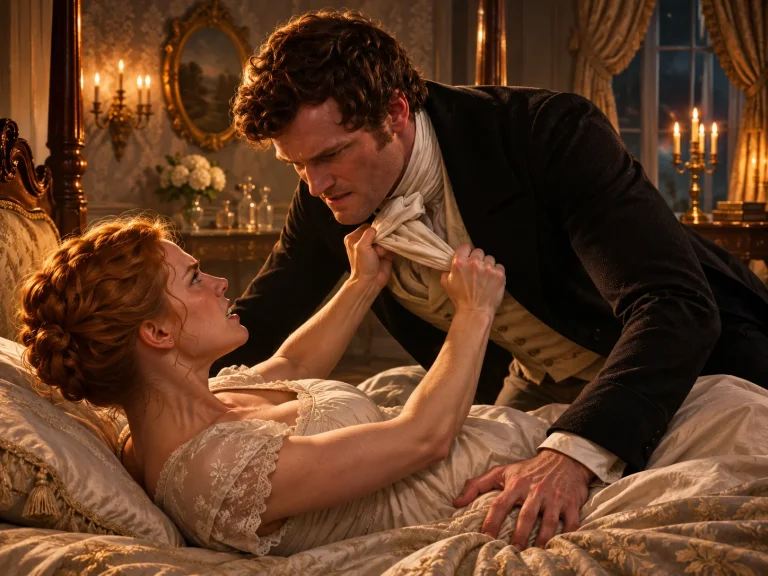
The wedding took place before Michaelmas. Catherine walked down the church aisle with a numb face and no expectation of happiness. Frederick behaved politely before witnesses. At home he reminded her that her family’s security depended on his good opinion. Elias returned weeks later to find the woman he loved bearing his brother’s name.
They had avoided one another with the careful courtesy of people convinced that anger would reveal longing.
Now, outside the Abbey at midnight, Nora helped Catherine into a carriage. Catherine looked at the dark windows and understood something painful. For three years she had blamed herself for believing a letter. She had never considered who benefited from both of them believing the same lie.
—
Lady Harrow received Catherine in a dressing gown, carrying a candle and a poker. When she recognized her young neighbor, she abandoned the poker, took one look at the torn sleeve, and led her to the hearth.
“Nobody follows you into this house without my permission,” the widow said.
Catherine sat beside the fire while Nora described the broken door and the hurried departure. Lady Harrow listened without asking whether Catherine had provoked her husband.
At Briarcliffe, Frederick accused Elias of stealing his wife. Elias answered that Catherine had left by choice, then moved away before rage turned the argument into another struggle. Their father was staring at Beckett’s dates. The duchess demanded the paper be burned.
“Why?” Elias asked.
“Because frightened servants invent histories to make themselves important,” she replied.
Beckett looked directly at her. “The parish church kept its own copy.”
The duke ordered both sons out. He wondered why an old church record could frighten his mother more than a woman crying behind a locked door.
Before dawn, Catherine wrote a statement for Lady Harrow’s solicitor. She included her husband’s demand that she bear a child, the force he used to restrain her, and the repeated threats to her relatives’ security. She described her past affection for Elias plainly, refusing to let anyone use it to excuse what had happened.