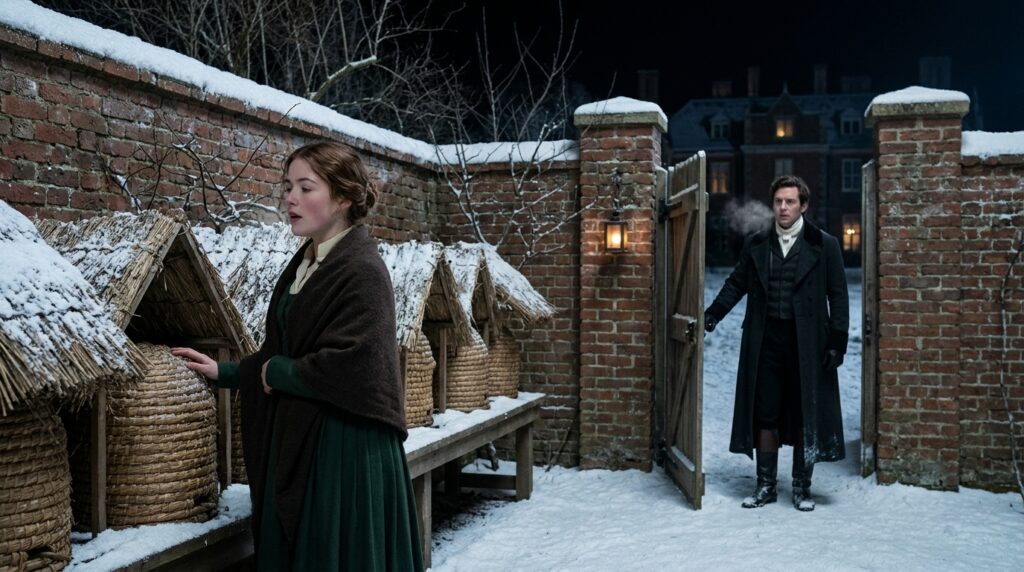
The snow came in earnest 3 days before St. Thomas’s day. It came down out of a yellow sky all one afternoon and all one night, and in the morning the world was white to the tops of the hedges. The lane that ran up the ridge to the far cottages was drifted shut in two places. The farm wagons could not get through.
The steward stood in the coal yard in his great coat and said reasonably that the dole would have to wait for the thaw. It might be a week. It might be a fortnight. These things could not be helped.
“The old man above the hop garden has no coal now,” Rosamund said. “He will not last a fortnight. Nor will the widow at the bottom of the lane.”
“The wagons cannot get through, Miss Marthorp.”
“Then we will not use the wagons.”
She had thought about it all night, lying awake under the eaves with the snow ticking on the window. The lane was drifted, but the old footpath along the top of the hedgebank was blown nearly clear because the wind came across it. Men could walk it with a sack on their backs. And her father’s oast house stood at the top of the lane with a great round drying floor under its roof and a kiln that could be lit.
The women could come there out of the cold and share out the beef and the bread, and every family could fetch its own from a warm room instead of a frozen yard. She said all this to the steward in the coal yard with her breath smoking. He looked at her as though she had grown a second head.
“The men will not carry coal on the word of a stillroom maid,” he said.
“They will if their own children are cold,” she said.
And she was right.
She went down to the village that afternoon and knocked on doors. She went to the blacksmith first because the others would follow where he went, and then to the shepherd, and then to the young men, who had sat idle since the hop harvest failed.
By the next morning there were a dozen of them in the White Hold coal yard with sacks and shovels, stamping and blowing on their hands. Rosamund had the grooms fill the sacks and the gardeners sweep the path along the hedgebank. Her father, who could not lift, sat by the kiln in the oast house with every family on the ridge in his head. He knew who was ill and who had a new baby.
He knew who was too proud to come and must have it carried to the door. Her mother and the women of the lane laid the beef out on the drying floor. It was a strange sight, all that meat on boards in the room where the hops should have been.
She was in the coal yard at midday, counting sacks out of the gate, when she looked up and saw the Duke. He had come down from the house on foot in an old riding coat she had never seen him wear with a muffler round his throat and his hat pulled down. The men by the coal heap went quiet one after another and pulled their caps off.
He did not seem to notice. He walked straight across the trampled snow to where she stood with her hands full of tally sticks. He looked at the line of men and at the sacks and at the path along the hedgebank where the first of the carriers were already small dark shapes against the white.











