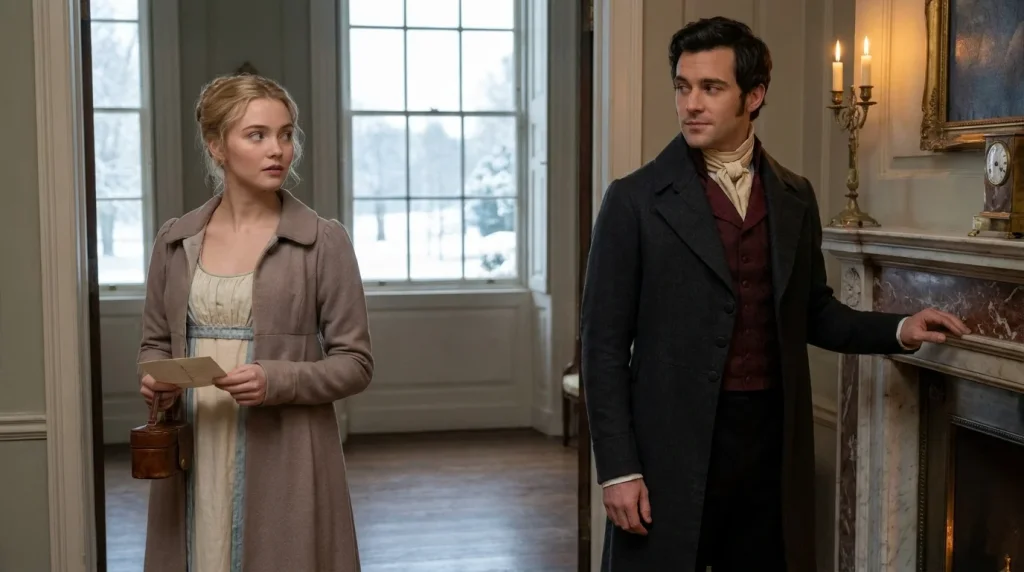
She had paid for an inside seat. That was the first thing, and she held on to it all the way up the hill, because it was the only thing about that day that had been fair. Eleven shillings for an inside place on the Shrewsbury coach, counted out with painful care on the third of November, 1823, and put into the hand of a guard who had smiled at her at Church Stretton. A gentleman in a travelling cloak had wanted to sit inside, and he had paid considerably more than eleven shillings.
The guard had not smiled the second time. He had given her back four shillings, said that was generous, and helped her up to the roof with one hand under her elbow as though he were doing her a kindness. She had ridden the last nineteen miles outside in sleet. It came sideways off the hills and found every opening in her bonnet. Nobody spoke to her. The man beside her on the roof was asleep, or wished her to think so.
At the coaching stop in Market Rexley, the carrier looked at her trunk and then at her and said it was a shilling to take it to the house. She had ninepence. She said so plainly because there was no other way to say it. He looked at the trunk again. It was small and old, with her mother’s initials almost worn off the lid, and it held everything she owned.
“Ninepence to the lodge gate,” the carrier said. “Not a step farther. The drive is a mile, and His Grace does not like carts on it. Ninepence to the lodge gate.”
Miss Esme Elwood was twenty-four. She had kept her father’s parish accounts since she was fourteen and the school registers since she was sixteen, and she could add a column of forty figures in her head faster than most men could find a pencil. None of that was any use on the drive to Rexley Park in the November dark. What was useful was that she was strong and the trunk had a leather handle at one end. She took hold of it and began to drag.
She thought about her father while she did it. That was a mistake, but it passed the time. He had stood in the schoolhouse doorway at Saltley that morning in his old black coat, holding her hands, and told her that the Duke of Rexley wanted a housekeeper. He had said it was a decent place and a safe one, and that she would be safe there. He had not looked at her once through any of it. He had looked at the gate, the road, and the sky.
At the end he had added one more thing.
“Keep your eyes open, as you always do.”
She had not understood that. She had put it away to understand later, as she put away a sum that would not come out. The house appeared suddenly out of the darkness at the top of the drive, as large houses do. A long grey front, two wings, forty windows, and lights in about six of them. The handle of the trunk had cut a red line across her palm. She did not stop to look at it.
She climbed the steps and rang. A footman of about eighteen opened the door, looked at the trunk, and took her for a delivery.
“Tradesmen’s entrance is round the side, miss.”
“I am not a tradesman. I have been asked to come. My name is Elwood.”
He did not believe her, but he was too young to say so and too cold to argue with the door open. He brought her into the hall, told her to wait, and went away. The hall at Rexley was laid with black and white stone, like a chessboard for giants, and it was colder inside than out. A fire had been laid in the enormous fireplace but not lit. Above her a clock ticked with a slow, dry cough, and from behind double doors standing a hand’s breadth open on her left came two voices.
One belonged to a woman. It was elderly, polished, and very tired of saying the same thing.











