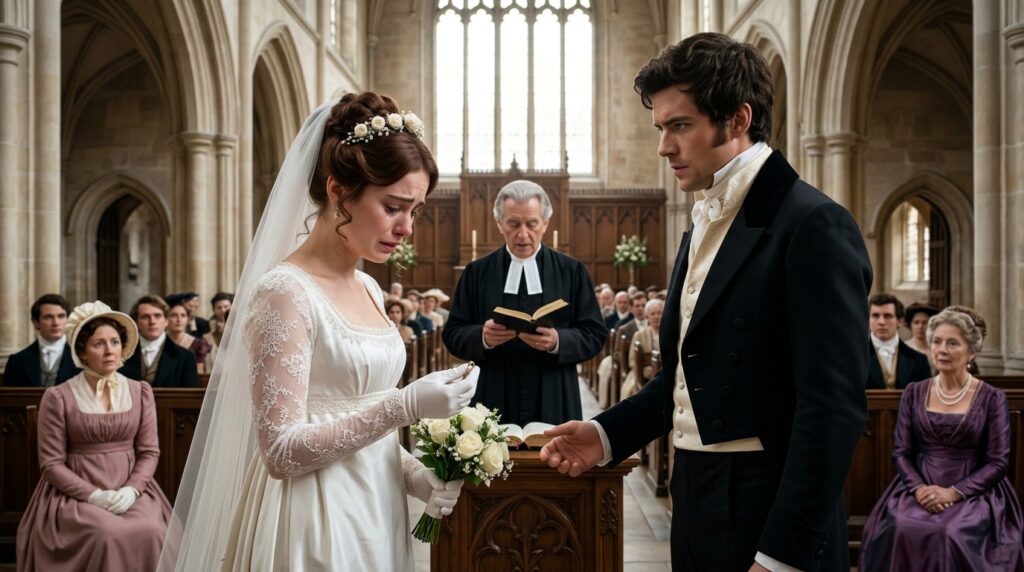
They reached the estate just as the sun was going down. The church bells in the village were ringing for them, and the whole household stood lined up on the front steps, from the butler down to the smallest kitchen maid. May smiled and nodded at every one of them until her cheeks ached. She had played in this house as a little girl, hiding under the billiard table and stealing biscuits from the pantry.
And now every servant who had once chased her out of the kitchen was curtsying to her as the Duchess. It was the housekeeper, Mrs. Hobbs, who showed them upstairs. She led them along the east corridor, stopped before a pair of doors, and opened the first with a little flourish.
“Her Grace’s bedchamber,” she said.
Then she opened the second:
“And His Grace’s, just here.”
She crossed the first room, laid her hand on the third door in the wall between them, and gave May a smile that was far too knowing for a woman of 60.
“And of course, the connecting door.”
Then she curtsied and left. And the silence she left behind was enormous. May stared at the door. Henry stared at the door. For one wild moment, May thought the door might be staring back.
Two rooms. Of course, there were two rooms. Every duke and duchess in England had two rooms. She knew that.
So, why did she feel as though someone had just tipped a bucket of cold water over her head? And why could she not decide whether it felt like relief or disappointment? It was relief, she told herself firmly. It had to be.
She had waited for Henry her whole life, but she would not give herself to a man who did not love her. Not even Henry. Especially not Henry. A room of her own meant she would never have to.
“Well,” she said brightly. “Two rooms. How sensible. Very sensible. It is a very roomy house, Henry. Roomy and sensible.”
Henry said nothing. He was still looking at the door, and May realized with a sudden swoop in her stomach that he had not thought of this either.
“Henry,” she said slowly, “we never talked about this, did we?”
“No,” he admitted.
“About where we would sleep? For a whole year.”
Her voice was climbing now, and she could not stop it.
“And your mother will expect an heir, Henry. She will be counting the weeks. She is probably counting them already, in the carriage on the way home, on her fingers. And the maids change the sheets. And maids talk. And if nothing ever happens, then everyone will know nothing ever happened. And how on earth are we meant to produce a child out of nothing, Henry? Nobody has ever done that. Not even in novels.”
She could see it perfectly. The dowager duchess at the breakfast table a year from now, knitting tiny white booties with her eyes narrowed at May over the needles. ‘Still nothing, Your Grace.’
“May.”
Henry’s voice was quiet and it stopped her at once. It always had. He crossed the room and took both her hands in his and she felt the panic begin to drain out of her the way it always did when he looked at her like that. Steady and sure.
“We will manage it,” he said. “One day at a time. Nobody will know anything we do not want them to know. And nothing will happen that you do not want.”
His thumbs moved once over her knuckles.
“You have my word.”
May looked up at him. He meant it kindly, she knew. He was being a gentleman and a good friend, the way a man is fond of a favorite sister.
She smiled and nodded and wished she had never heard Louisa Fenwick’s voice. Henry let go of her hands. At the connecting door, he paused.
“It locks from your side,” he said and then he went through it and it closed softly behind him.
May did not turn the key. She told herself it was because she was tired. She undressed with her maid’s help, climbed into the enormous bed and lay staring at the ceiling while the house settled into silence around her. Somewhere a clock chimed 11, then 12.
She could hear nothing from the other side of the wall and that was somehow worse than any sound. Was he asleep? Was he lying awake, too? Was he thinking about her or about Louisa Fenwick in some candlelit room in Oxford?
On the other side of the wall, Henry had not even undressed. He sat by the dying fire in his shirt sleeves with the glass of brandy he had poured an hour ago and never touched. He kept seeing May’s face in that little sitting room, white and lost with Louisa standing over her. Whatever Louisa had said, May would not tell him and he could not ask without risking the very thing he had spent years trying to bury.











