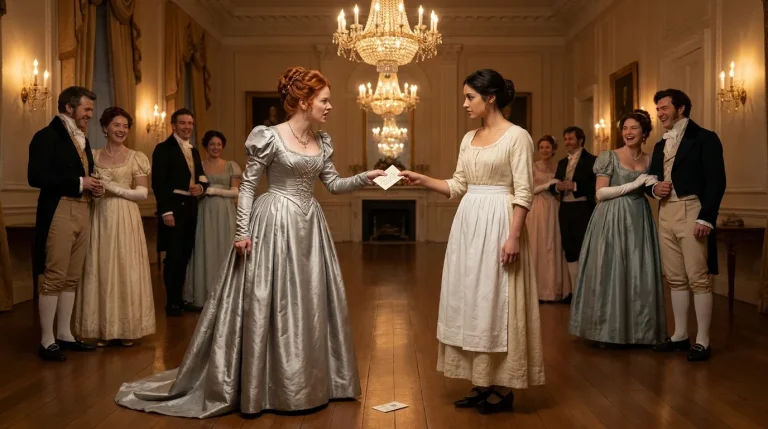
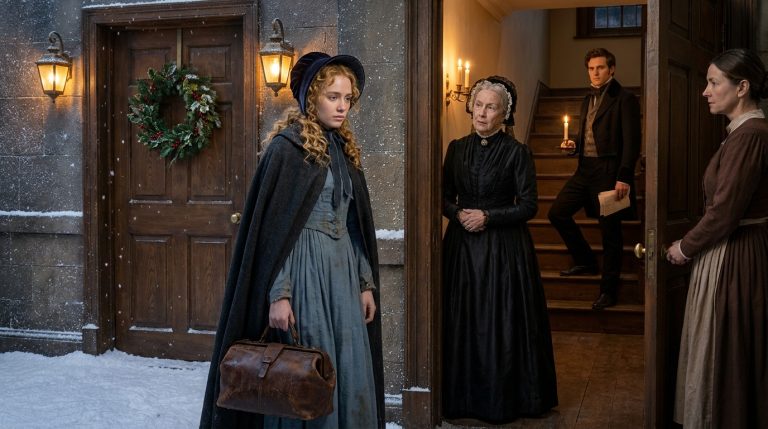
It happened two days before Christmas, as important things almost always happen, by a side door, in the middle of something else. The charity school gave a little performance for the family every Christmas. The Duke went because his mother had always gone, Tabitha because Hannah would be there, and Avis because Tabitha would not go without her. The schoolroom had been swept and dressed with holly. There was a fire for once, because Avis had quietly paid for the coal herself.
Thirty-one children stood in two rows, their hair damp and smoothed down. Miss Lowe stood before them, raised her chapped hands, and spoke.
“And now, as every Christmas in this room, the founder’s round.”
The children began to sing, and Avis stopped breathing. It was “The Bell on the Gable.” It was her father’s round, note for note, the one she had sung in the estate office a fortnight earlier from the big brown book. Thirty-one children she had never seen before December were singing it perfectly in three parts, in a school in a valley she had never heard her father mention. She turned her head and saw that the Duke had turned his. He was looking directly at her.
When it was over and the oranges had been given to the children, he went straight to Miss Lowe.
“Where did that round come from?”
“The first master, Your Grace. We have sung it here at Christmas since the school opened. The old Duchess never let it be forgotten.”
“What was his name?”
Miss Lowe went to the shelf, took down the first school register, and opened it at the first page. Beneath the old Duchess’s signature, in a small and loving hand Avis would have known anywhere, stood the words: John Tennant, Master. Michaelmas, 1797.
Thomas Bell found her ten minutes later outside the school door in the cold, with her arms wrapped around herself. He stood beside her for a moment without speaking.
“I wondered when you would hear it, miss,” he said. “You stand exactly as he did. Head on one side, listening as though the world were a tune someone was playing a little out of key.”
“You knew him?”
“I dug his garden for him. A gentleman. He had a little girl born in the schoolhouse in the winter of ninety-eight.”
The old gardener glanced at her.
“I never knew her name was Avis. I never heard him call her anything but Wren.”
“Why did he leave?”
Thomas Bell looked at the frozen river.
“He asked a question, miss. Asked the late Duke’s secretary where the rest of the school’s coal money went. He asked in a letter, very respectful. Then he asked again. By Lady Day he was gone, without a character and without an explanation.”
He paused.
“The secretary’s clerk that year was a young fellow just come from Hexham with a very fine hand. His name was Crowe.”
That night she went down to the estate office, although it was not Thursday, and found the Duke already there. He had the great ledger for 1801 open before him. He said nothing, only turned it toward her so that she could read. Mr. J. Tennant, schoolmaster, dismissed by order of the secretary. Last quarter’s salary withheld.
“I was eleven,” the Duke said. “I used to run away from my tutor and go down to the school, because the master let me sit at the back and sing. I thought he was the most admirable man in the world. One day he was gone. When I asked, they said he had left for his health.”