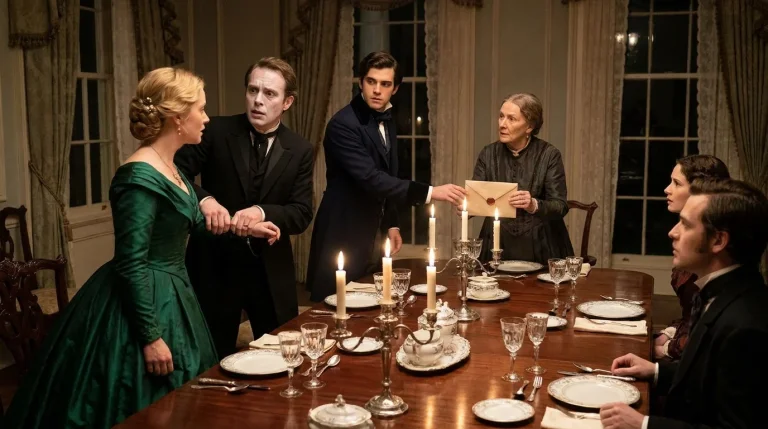
“There is no Robson thatching roofs in this valley,” Thomas Bell said loudly from the back. “Never has been.”
“And we never had a penny,” Mrs. Dorcas Bell said beside him, her hands clasped in her apron. “We were told His Grace had stopped it.”
“Robert Bell can write his name,” Avis said. “His son taught him last winter, at this table. James?”
James Bell came between the benches carrying a slate. His father followed, limping on a stick. Before the whole room, Robert Bell took the pencil and wrote, slowly and very large: R. Bell. Then he looked at it as though he could scarcely believe it himself, and held it up. No one said a word.
“These are the calculations of a disgraced woman,” Mr. Crowe said.
But his voice was no longer quite pleasant. Then Lady Beatrice Tyndall stood. She told everything in a clear, shaking voice, with her father three meters away: the proposed settlement, the locked door, the eleven days, and Dr. Haddo’s papers.
“Miss Tennant gave me her own money and opened my door. My father told the whole county she did it out of spite. I let him, because I was a coward. I am not one now.”
She put her sworn statement on the table beside the gloves.
“Beatrice,” Lord Tyndall said in a dreadful voice.
“No, Papa.”
He remained still for a moment, his face working. Then he took his hat and left the schoolroom. No one stopped him. Only then did the Duke speak.
“I have said nothing this morning because it was not mine to say. Miss Tennant found every figure you have heard. She found them while teaching my niece to play again, and was sent out of my house for it, in my absence, without a character. I believed Mr. Crowe for two years because he was the only man who seemed to understand my brother’s books. I should have asked why.”
He looked around the table.
“Mr. Price, you are a magistrate. I cannot sit in judgment upon my own servant.”
The Reverend Price, who had never raised his voice in his life, ordered that Mr. Crowe be detained for examination before the Morpeth magistrates. He sent James Bell to fetch the constable. While they waited, Mr. Crowe stayed at the end of the table with his beautiful hands folded upon the ledger. He spoke once to Avis alone, so quietly that only she and the Duke heard.
“Your father asked the same questions. I was twenty-two. I carried his letters to the old secretary and saw what they did to him for asking. I learned that night what honesty costs in this county.”
“So did I, Mr. Crowe,” Avis said. “I learned it at Tyndall. I simply chose to go on paying.”
When the constable had taken him away, Lady Griselda Heddon rose from the trustees’ table. She was very straight and very pale. She took a folded paper from her bag, crossed the room, and gave it to Avis before everyone.
“I wrote this at six this morning, before any of this, because I had already gone through the estate office myself after you left, found what you had found, and understood what I had done. It is a character, Miss Tennant. It states that you are honest, capable, and kind to children, and that you were dismissed from my nephew’s house through my own error and an unjust suspicion.”
Her mouth trembled a little.
“It is late.”
“It is true.”
Avis took it. For a moment she could say nothing. Then, from the front bench, a small, hoarse voice spoke.