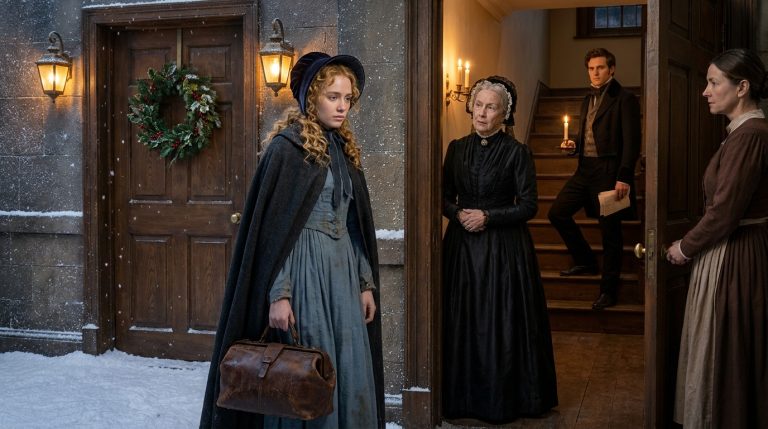
Coldmarten was a house of closed doors, and Avis learned them one by one. The music room on the south front was locked; Mrs. Elsdon kept the key, and no one asked for it. The late Duchess had played there. The late Duke’s study was locked too, as was the nursery where Tabitha had slept until she was eight. Lady Griselda’s drawing room was not locked, but might as well have been, for she received the governess there once a week to hear the report of the lessons and kept her standing.
Then there was Tabitha. Lady Tabitha Heddon was ten, small and pale, with a pointed chin and black ribbons still in her hair, two years after there had ceased to be a reason to wear them. She came to the schoolroom at nine every morning because she was told to, sat at the table with her hands tucked beneath it, and looked at the wall. She did as she was asked. She wrote her copies in a careful hand and did her sums without a mistake. She did not say a word.
Avis did not try to force her. She herself had once been a frightened child in a house full of adults who wished her to be happy. She remembered how every question laid a weight upon her shoulders. So she asked none. She spoke briefly about what they were doing and allowed the silence on the other side of the table to be a perfectly acceptable answer.
There was an old square piano in a corner of the schoolroom beneath a cover, so out of tune that middle C sounded like a door hinge. Avis borrowed a tuning key from the village organist and spent three evenings on her knees with her sleeves rolled up, while Tabitha did her exercises and pretended not to watch. On the fourth evening, after the child had gone to bed, Avis sat down and began to play.
She played every evening after that, with the schoolroom door ajar. Nothing grand, only pieces from her father’s songbook: old psalms, country airs, and the little rounds he had written for the children at his school. She played softly, for this was a house of whispers, and did not look toward the door. On the sixth night, she heard the third stair creak. On the ninth, the creak came closer and stopped. By the end of the second week, a small figure in a white nightgown sat on the landing outside the schoolroom door, knees drawn beneath her chin, every night until the last note.
On the fifteenth night, Avis played the old Northumbrian air, “The Water of Tyne,” and deliberately played a wrong note at the turn of the second line.
“That is wrong.”
The voice came from the doorway. It was small and hoarse, like a hinge that had not opened in a long time. Avis did not turn. She played the line again, making the same mistake in the same place.
“It goes up there. It does not go down.”
The voice was nearer now, and indignant.
“My mother used to sing it. It goes up.”
Avis took her hands from the keys.
“Will you show me where?”
There was a long silence. Then a small, cold hand reached over her shoulder and pressed a key firmly, as though crushing a beetle.
“That one.”
“Thank you,” Avis said, and played the note correctly.
When she finished, the doorway was empty. The next evening, however, Tabitha came all the way into the room and sat at the end of the bench beside her. After a quarter of an hour, she spoke very quietly.