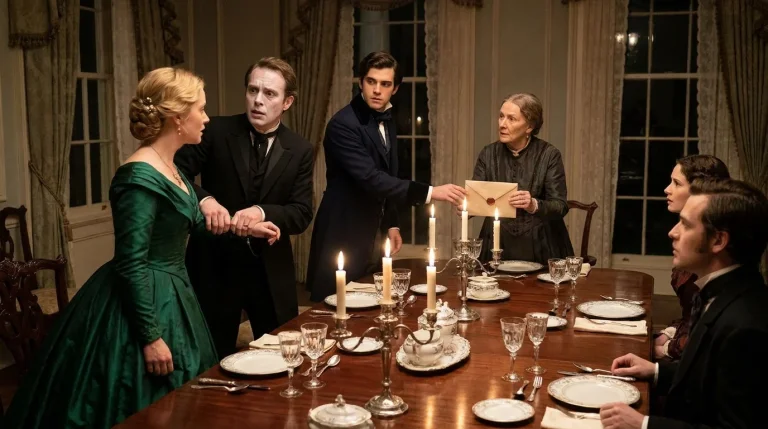
He looked at the page.
“I believed it for twenty-three years.”
“He never told me,” Avis said.
Her voice had become very thin and distant, and she could not seem to bring it back.
“Not where he had been, or why. He used to sing me that round when I was little. I thought he had written it for me. He died without his last quarter’s pay and never said one word against anyone.”
She found she was sitting on the edge of the hearth without remembering having sat down. She was trembling all over with the cold, helpless shivering that comes after a fall. She had come to this house with four shillings and a penny, a stranger. She had been grateful to be admitted at the kitchen door. All this time her father’s tune had been sung at the school every Christmas, and his name was in its register from the winter she was born.
The Duke came around the table and knelt on the hearth before her so that he was at her level. He took her hand. Her gloves lay on the table beside the great book. Her hand was bare, rough, and cold, and she tried to draw it away. He did not release it. After a moment, she stopped trying.
“No one else alive could have told you,” he said quietly. “There is no one left in this house who was here that year except Thomas Bell, myself, and Crowe. You could have taught at Coldmarten for forty years and never known.”
“I know.”
She looked at his hand around hers.
“Thank you. There is no office in England I could have gone to and asked for that. Not for money or anything else.”
They stayed like that for a while, longer than either could afterward account for. Then she took her hand back, stood, and said she would find the school accounts for 1801 if he fetched the candle. He agreed. They were both very relieved to have something to do.
The estate office door was not quite shut. Lady Griselda Heddon, who had been sleeping badly and had come downstairs for a book, stood in the dark passage with her hand on the wall. She watched her nephew kneeling on the hearth in his own office, holding a governess’s bare hand. She watched for perhaps half a minute. Then she went upstairs without her book and lay awake until morning.
She was sixty-three. She had kept her brother’s house for forty years, then his son’s after him, and no one had ever knelt before her. She thought that he was not going down there for the account books. Then she thought of the county and what it would say. Then, because she was not stupid, she thought of what would be done to the girl, because it was always the girl who paid. Lying there, she did not know which frightened her most.
On Christmas morning, Tabitha came into the schoolroom, where her uncle had been told to wait. Without a word, she sat at the old square piano and played “The Water of Tyne” from beginning to end, with the note rising in the right place. When she finished, she turned on the bench.
“You may turn the pages next time, Uncle Piers. Mama always let me.”
“Thank you, Tabby,” the Duke of Coldmarten said in a perfectly steady voice.
Then he went to the window and stayed there for a long time. In the second week of January he asked Mrs. Elsdon for the music-room key. He opened the room himself and stood a long time on the threshold, looking at the covers and the closed shutters. Then he went in and opened the shutters one by one, letting winter light fall over his sister-in-law’s piano. By the end of the month, Tabitha had her lessons there.