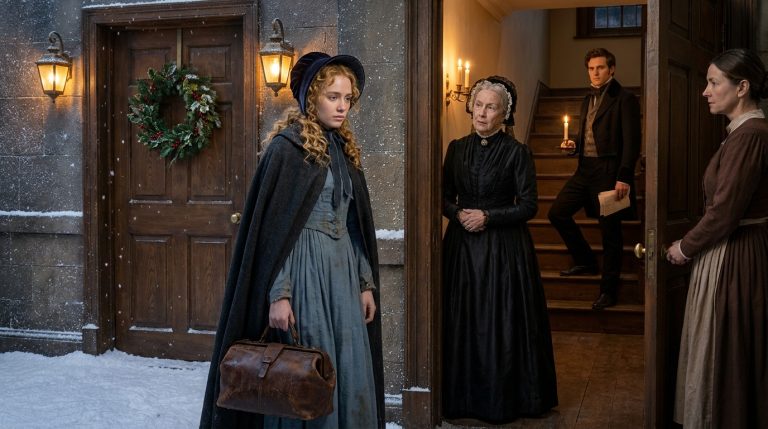
“It is at the end of the corridor,” he told the window after a moment. “It looks over the orchard. It is not grand. The chimney draws well.”
“Thank you, Your Grace.”
She had recovered her voice, more or less.
“You may thank me in a month, Miss Tennant, if you still wish.”
He did not turn.
“I should tell you that I do not yet know whether you are telling the truth. I only know that no one appears to have troubled to find out. That seems a very poor reason to send a woman into the hail.”
The room at the end of the west corridor had whitewashed walls, an iron bed, a fire someone had already lit, and a steaming jug of hot water on the washstand. Avis closed the door, sat on the bed in her soaked cloak, buried her face in her mended gloves, and at last wept, as quietly as she could, for a long time. Then she slept for eleven hours.
She had been at Coldmarten a week when Lady Griselda gave her first dinner of the winter. The rector came, the Reverend Samuel Price, a stout man, accompanied by his wife. Mr. and Mrs. Selby came from Biddlestone. Mr. Nathaniel Crowe, the estate secretary, dined with them as he did when a sixth gentleman was needed at table. He was a neat, quiet man of forty-five, with beautiful hands, who had served the family for twenty-three years. He was the only person in the house who had taken the trouble to be pleasant to the new governess. He had shown her the schoolroom himself and asked very politely whether she needed anything.
After dinner, Lady Griselda sent for her.
“You will play for us, Miss Tennant. I should like our guests to judge what my nephew has employed.”
Avis came down in her one good gray gown and sat at the drawing-room instrument. Mrs. Selby looked at her through her lorgnette.
“Well. Not the Tyndalls’ governess. Piers, my dear, how brave of you.”
“His Grace has a generous heart for causes,” Mr. Crowe said pleasantly, before the Duke could answer. “Miss Tennant is one of his causes. We are all very curious to see what she is worth.”
Avis played a Clementi sonata. She played it well. She knew that because her hands stopped trembling at the third bar and did not begin again. Mrs. Selby talked throughout the first movement about her new carriage horses.
In the pause, Lady Griselda said, “Something more cheerful, Miss Tennant. What did the Tyndall girl like to hear? Something to run away to?”
The Selbys laughed, while the rector’s wife looked at her lap. Avis began the second movement. Halfway through, Mrs. Selby leaned toward Lady Griselda and spoke in a voice that carried.
“How beautifully they are taught to play. One would scarcely suspect it.”
Avis finished the movement, rose, bowed to the company, and turned to leave. The Duke stood. He was the only man in the room who did. The rector, after a startled moment, half rose. Mr. Crowe did not move at all.
“Miss Tennant,” the Duke said. “The second movement again, if you please. I did not hear it over the conversation.”
He looked gently at Mrs. Selby.
“Nor did anyone else, I think.”
No one could do anything but be silent while she played. So they were silent, and she played to the end. For eleven minutes, the drawing room at Coldmarten was so quiet that she could hear the fire crackle.
Upstairs, in the room at the end of the west corridor, she took off her gloves and stood for a long time looking at her bare hands. He had not defended her. He had not said one word about Tyndall. He had only made them be quiet and listen. It was not much. It was the first thing she had been given in that county without having to beg.