“I mean, spare an old woman a crust of bread, miss, and God will spare you another.”
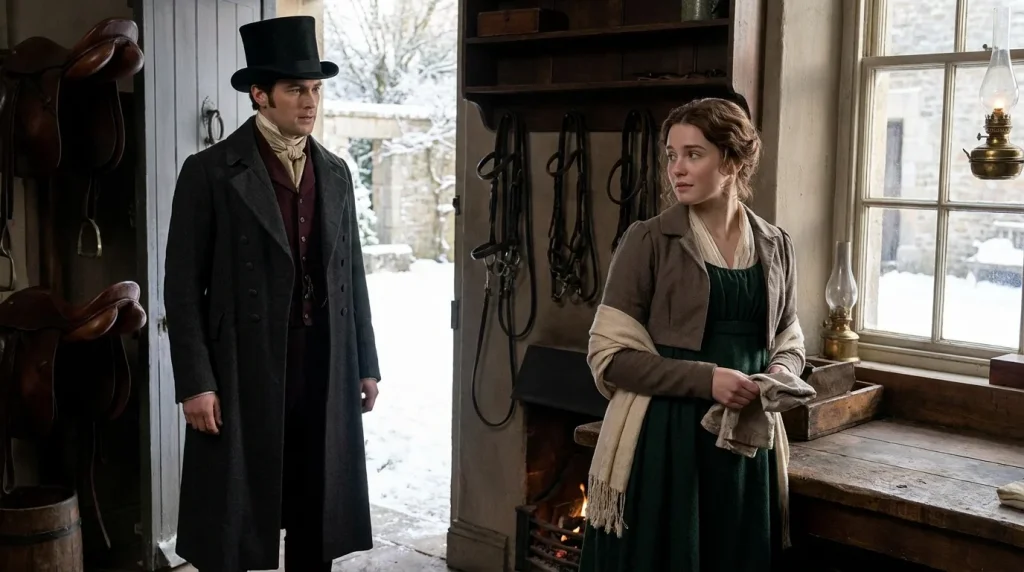
The voice came out of the fog before the woman herself appeared. Anne Chanstone stopped on the narrow lane, her father’s plain snaffle bit slung over her shoulder. It was the gentlest sort of bit a horse could wear, a jointed bar with a ring at each end, and she had used no other kind since she was twelve.
She was walking home from the Duke of Edingham’s stables at Marsh Court, as she did every evening that autumn, and the October fog had climbed the valley to meet her. It lay so thick along the churchyard wall in Monkdale that the stones seemed to breathe it out. There, on the old mounting block beside the gate, sat a bundle of brown cloak with a face inside it.
An old face, pinched with cold. A cap was tied beneath the chin, a hood drawn over the cap, and the hands protruding from the cloak were wrapped in rags. Below the hem, Anne could see two shoes that had ceased to be proper shoes miles ago.
The baker’s boy passed with his tray without looking back. Two women carrying baskets walked by, studying the opposite side of the street with great concentration. The innkeeper’s wife put her head out of her doorway.
“Don’t come onto my steps, mother.”
Then she shut the door, though the mounting block was nowhere near her steps.
Anne was not much given to heroic gestures. She simply said, “But my father’s kitchen is three doors from here. There is a fire in it, and a mutton pie too large for two people. Would you come and help us eat it?”
The old woman looked up. Beneath the hood her eyes were sharp and black. For one instant they traveled over Anne from bonnet to boots as a dealer might look over a horse.
“I’m not fit for a kitchen, miss. Look at my shoes. I’ve had trouble getting into kitchens before.”
“Your shoes won’t matter,” Anne said.
She took the old woman’s arm and guided her slowly down the lane. The Chanstone house stood at the end of it, where the lane met the river. Behind the house were a yard and stables, and somewhere beyond the white water a millwheel turned.
Anne pushed open the door with her hip. She did not seat her guest on the bench beside the entrance, where traveling peddlers and tinkers generally sat. She led her straight to her father’s chair, a great oak armchair with a patched red cushion. For twenty years no one but her father had sat in it. Anne settled the old woman there as if it were the only suitable place in the house.
Then she knelt at the hearth, untied the ruined shoes, removed the wet stockings, and placed the old woman’s feet upon folded cloth she had warmed by the fire. She set the kettle on and climbed onto a stool to take down the good cup from the highest shelf. It was blue and white with a matching saucer, brought out only for the vicar and no one else. She filled it and placed it in the old woman’s hands before pouring any tea for herself.
“There, mother. Drink it while it’s hot. The pie will be ready in fifteen minutes.”
The old woman held the cup in both rag-wrapped hands and stared at it. She did not drink.
“Mother,” she repeated, as though trying the word for its proper shape.
The back door opened, and Anne’s father came slowly in from the yard, his knees stiff now that the damp had got into them. He was a broad, quiet, silver-haired man with a horse dealer’s patience. He saw the stranger in his chair. He saw the good cup. His eyebrows climbed nearly to his hairline and stayed there.











