“Father, we have a guest tonight,” Anne said. “She’s dining with us.”
Mr. Chanstone looked from his daughter to the brown cloak in his red chair. Then he bowed to the old woman, slowly and formally, as he would have bowed to a noblewoman or the vicar’s wife.
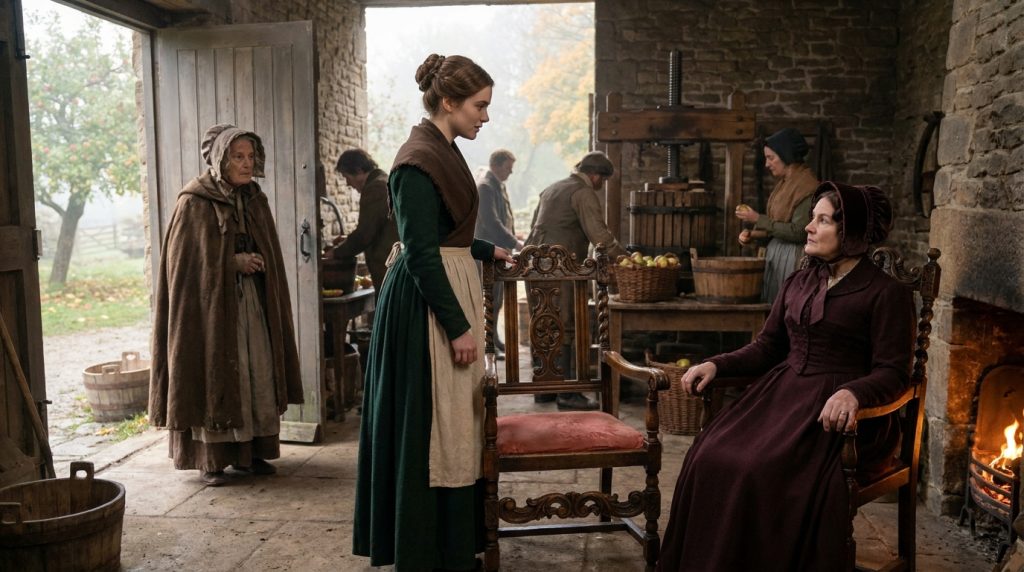
“You’re welcome, mother,” he said.
Turning toward Anne, he added in a voice as dry as chaff, “Upon my word, it’s as if the Queen herself had come to visit.”
The old woman burst out laughing. She lifted her teacup, laughed again in surprise, and at last drank.
She said her name was Nan. She had walked from Tideswell that day and was going toward Matlock, where she had a niece who might or might not give her a bed. She ate her pie in small, tidy bites, sitting very straight and watching everything. She watched Anne slice the bread. She watched Mr. Chanstone doze on the bench with his boots still on. She watched the fog turn blue outside the window as evening settled.
At last Anne sat beside her with a basin of warm water to wash her old feet, and Nan began to ask questions.
“You’ve been up at the great house, haven’t you, miss? I saw you coming down the hill.”
“I work there,” Anne said. “In the stables. The old Duke bred four young horses before he died, and no one taught them any manners. The grooms were rough with them, and now they kick, rear, and refuse to obey. The new Duke hired me in August to make them fit for sale. I have them until the October fair at Bakewell. After that I come home.”
A girl working in a duke’s stable. Nan’s mouth tightened at the corners.
“I imagine the village has plenty to say about that.”
Anne laughed, which Nan had not expected.
“The village says I shall be a duchess by Christmas. It also says the miller’s wife is a witch because her bread rises better than anyone else’s. I take no notice of village talk.”
“And what does the Duke say?”
“His Grace says very little to anybody, mother. He came home from Cambridge two winters before his father died, and he still wishes he were there. He reads Greek in the tack room when he thinks no one can see. He loses a pair of gloves every week. The grooms keep a basket of them beside the door.”
She smiled down into the basin.
“His name is Edward, and he is the kindest man in the district. He will marry some lady who can read Greek back to him. That is all there is to be said about the Duke.”
She gently brought the old woman’s hands out from beneath the cloak, stripped away the wet rags, and rubbed the fingers between her own to restore their warmth. They were cold as stones. They were not quite the hands Anne had expected, either. The palms were soft, and along the insides of the third and fourth fingers of the left hand ran a narrow, hard, smooth old ridge, the place where reins had rested for forty years.
Anne’s thumb lingered on it for a moment. Somebody’s horses, long ago, she thought. She said nothing and went on rubbing.
When the pie was finished and the fire had burned low, Nan rose to leave. Anne would not hear of her taking the road after dark, but the old woman would not stay. A carter, she said, was taking her toward Matlock and waiting at the bridge. So Anne gave her dry stockings from her drawer and her father’s second pair of boots, stuffed with rags at the toes. Finally she took her own best shawl from its hook, a warm piece of soft brown wool, and settled it around the old woman’s shoulders.











