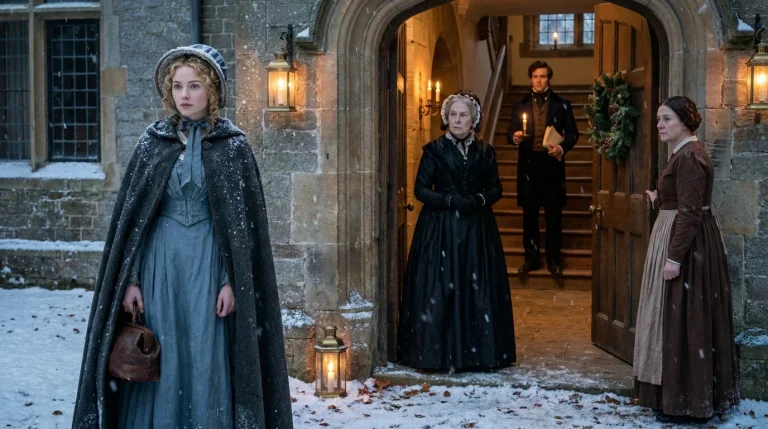
Lady Griselda sent for Avis on a wet Tuesday. She did not invite her to sit.
“I am going to ask you a question, Miss Tennant, and I should like you to consider before you answer. Do you sit in the estate office with my nephew in the evenings?”
“Yes, my lady. We are examining the accounts.”
“Yes.”
Lady Griselda’s voice was perfectly calm.
“Mr. Crowe has been kind enough to tell me that you are copying private estate figures into a book of your own. He has had a letter from Lord Tyndall, who tells him that you did precisely the same at Tyndall in the months before you helped his daughter disgrace him.”
She folded her hands.
“For myself, I do not believe the worst. You are not stupid, so I shall not speak as though you were. It does not matter what happens in that room. It matters what is said of it. By Lady Day it will be said that the Duke of Coldmarten keeps a woman from Tyndall’s house and gives her the run of his account books. When that has been said often enough, it will not be his name that is ruined.”
“I understand, my lady.”
“I hope so.”
Lady Griselda turned to the window. For a moment her voice was not calm at all.
“I have given my whole life to this family. I have nothing else in the world. I will not stand and watch it become a laughingstock, through his fault or yours.”
Avis went back to the music room, where Tabitha was waiting for her lesson. She sat at the pianoforte, put her hands on the keys, and understood, with the terrible clarity that always comes at the wrong moment, that she was in love with him and it would cost her everything she had.
She told him that evening what Lady Griselda had said, from the beginning, without holding anything back. He listened in silence.
“I shall speak to my aunt,” he said at the end.
“You will not, Your Grace.”
She put down the ledger.
“If you defend me to her, you will prove her right.”
“Piers,” he said.
She looked at him.
“My name is Piers. I should like someone in this house to say it once as though I were a person and not a title.”
“I cannot.”
“Say it once, so that I know what it sounds like.”
Their whole lives came to stand at the edge of the oak table and waited.
“Piers,” she said.
On the last Monday of February, he went to Newcastle to see the bank. For six years, a draft upon the estate account had been cashed there every quarter in the name of Hargrave and Company. He wanted to see for himself who was cashing it. He was to be away two nights. Avis thought afterward that Mr. Crowe must have known the date of the journey a fortnight ahead.
They were all summoned to the servants’ hall at eleven on Tuesday morning: Mrs. Elsdon and the butler, the maids and footmen, and the knife-room boy. Lady Griselda stood at the end of the long pine table, Mr. Crowe beside her with a small blue notebook in his hand. She was sorry, courteous, and pleasant throughout, which was the cruelest way of doing it.
“This is not a happy matter,” she said, “and I shall be brief. Miss Tennant, you will leave this house today. Mr. Crowe found this book in your room. It contains figures copied from His Grace’s private accounts. I do not say that you meant harm. I do not say anything at all.”
She let the silence remain, which did the work.
“But it is being said in the county that His Grace’s governess is not merely his governess, and I cannot stop that. What I can do is remove the cause. There is no error here, only a situation, and of the two people concerned, only one can be dismissed.”
“My lady,” Mrs. Elsdon said from the end of the table, “the girl has done nothing but good in this house.”
“I did not say she had done anything, Mrs. Elsdon.”
Still perfectly pleasant.